It Takes a War Review – A brief experiment in perspective, intention, and discomfort
 Avinash Rohra
It Takes a War is not a traditional shooter, and it is important to state that plainly. While it adopts the visual language of a first-person FPS, the experience is far closer to a short, narrative-driven vignette than a mechanically driven action game. It is designed to be completed in a single sitting, and its focus is not mastery, progression, or challenge, but observation, framing, and presence.
I played It Takes a War on PC, and my time with it was brief, contained, and deliberate. The game makes no attempt to scale itself into something larger than it is. Instead, it offers a specific moment, viewed through a familiar lens, and asks the player to sit with it.
Whether that moment resonates will depend heavily on expectations.
What the Game Actually Is
From a practical standpoint, It Takes a War is a short, single-player first-person experience structured around the flow of a multiplayer shooter match. You are placed into a simulated combat scenario alongside AI-controlled teammates. These teammates communicate with one another through voice dialogue, while the player character remains silent throughout.
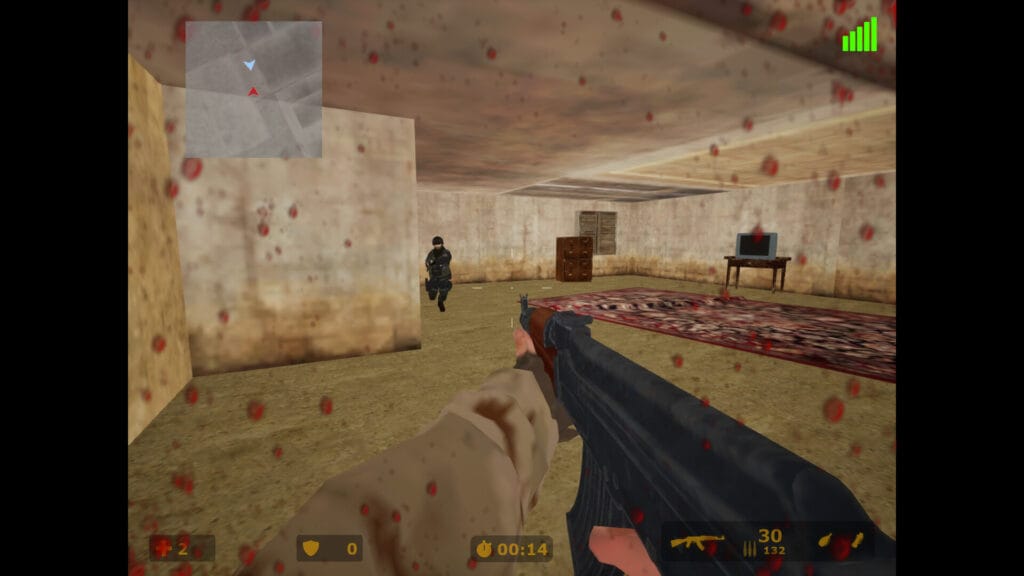
There are no progression systems, no unlock trees, and no tactical layers beyond basic movement and shooting. Weapons are limited, encounters are simple, and enemy behaviour is functional rather than dynamic. This aligns with player impressions on Steam, many of which note that combat exists primarily as context rather than as the core appeal.
The game can be completed in under an hour, consistent with the average reported playtime.
Intentionally Minimal
Mechanically, It Takes a War is extremely restrained.
You can move, aim, shoot, and reload. Encounters are straightforward and forgiving. Enemy placement is predictable, and there is little variation in how firefights play out. There are no difficulty spikes, alternate routes, or mechanical twists introduced over time.
This is not a matter of rough execution so much as intentional scope limitation. The shooting never evolves, and the game makes no effort to surprise the player through mechanics. Instead, it relies on repetition to establish familiarity, allowing the surrounding context to take precedence.
For players expecting skill-driven FPS gameplay, this will feel shallow. For those approaching it as an interactive narrative, the simplicity helps avoid distraction.
Visual Presentation: Functional and Deliberate
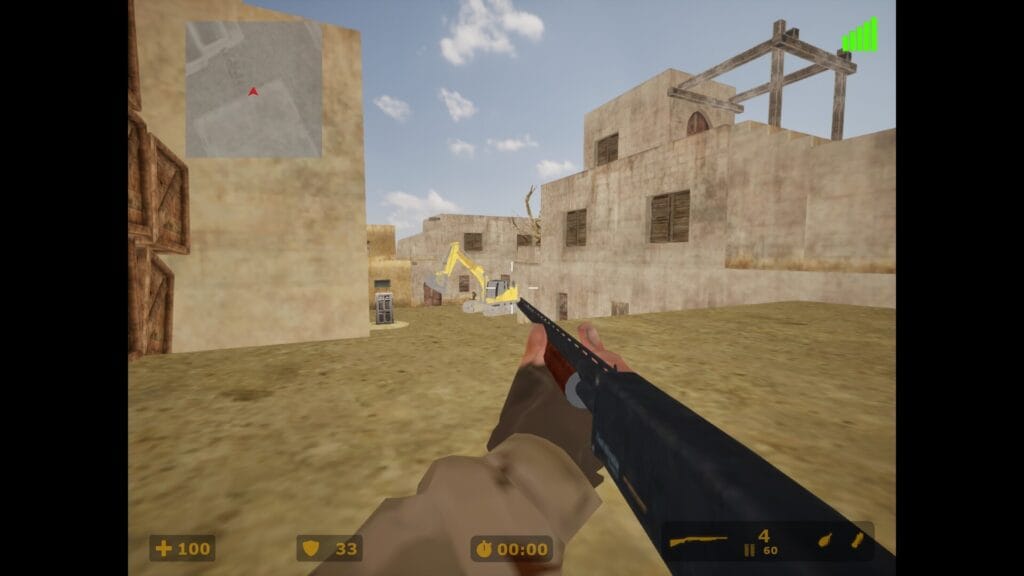
Visually, It Takes a War uses a low-fidelity, retro-inspired aesthetic. Geometry is simple, textures are flat, and environments are sparse. There is no attempt at realism or visual spectacle.
The presentation is not technically ambitious, but it is consistent. Everything on screen is readable, nothing competes for attention, and the visual style supports the game’s short runtime without calling attention to itself. Characters are easy to identify, spaces are simple to navigate, and the visuals serve their purpose without excess.
There are no set-pieces or cinematic moments driven by visuals alone. The graphics exist to establish place, not to impress.
The Core Delivery Mechanism
Where It Takes a War places its emphasis is audio.
Your AI teammates speak frequently, holding conversations that range from casual to tense. These exchanges continue regardless of player action. You are not required to respond, and you are not able to meaningfully influence the dialogue. This is clearly intentional.
The voice acting is consistent and clearly recorded, and it carries much of the experience’s emotional weight. Several player reviews on Steam highlight this aspect in particular, noting that the dialogue feels grounded and natural.
Notably, the game does not rely heavily on music. Silence and ambient sound are allowed to linger, reinforcing the feeling of being present while remaining emotionally detached.
Narrative Through Positioning, Not Plot
There is no traditional story structure here. No exposition, no conventional climax, no clear resolution. Meaning is instead implied through your position within the group and the contrast between action and conversation.
You are part of the match, but not part of the social dynamic. You participate physically while remaining verbally and emotionally absent. That disconnect is the point of the experience.
This approach will work for some players and leave others cold. Steam feedback reflects this split clearly: those who engage with the framing often describe it as thoughtful or unsettling, while those looking for clearer narrative payoff tend to find it underdeveloped.
Both reactions are valid, and both stem from the same design decision.
Final Thoughts
Final Score: 3 / 5
It Takes a War is best understood as an interactive idea rather than a full game in the traditional sense. It uses the shell of an FPS to explore perspective, presence, and detachment, but it does so without mechanical depth or narrative expansion.
It is short, minimal, and deliberately restrained. For players open to experimental experiences that prioritise mood and implication over agency and engagement, it may leave a lasting impression. For others, it will feel slight and incomplete.
That tension ultimately defines the experience.
This review is based on the PC (Steam) version, with the code provided by the game’s publishers.
About the Author