Avinash Rohra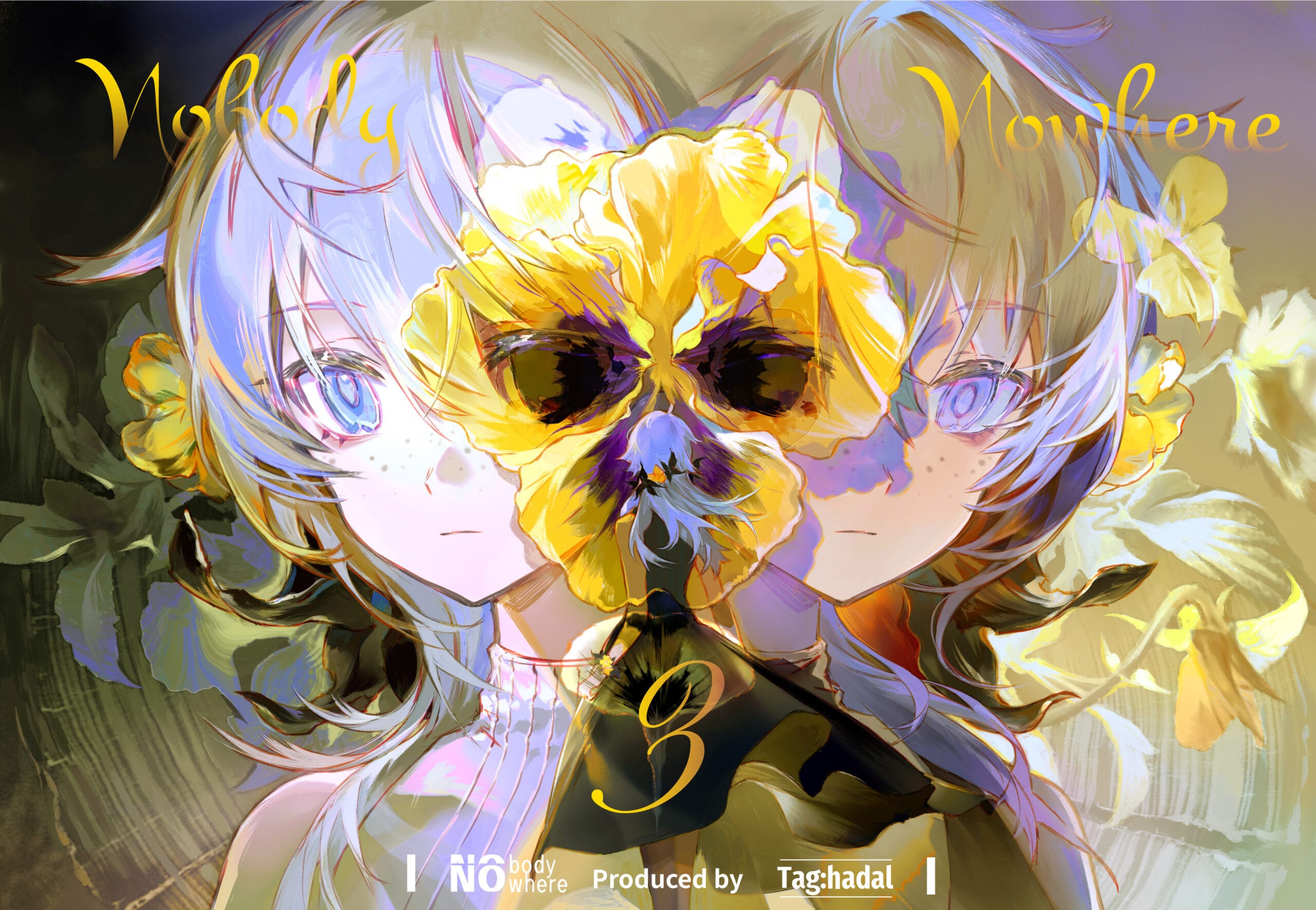
At a time when many narrative games rely on cinematic spectacle and branching decision systems, Nobody Nowhere distinguishes itself through restraint. Its pixel-art presentation, text-driven storytelling, and tightly controlled structure mark it as a deliberate, considered sci-fi experience rather than a maximalist one. Released on February 17, 2025, by developer 深渊标记 Tag:hadal and publisher 攻壳游戏 Gamker Studio.
More than a stylistic statement, this clarity of execution sets Nobody Nowhere apart. It is a thoughtful narrative adventure that balances exploration, pacing, and thematic focus without overextending itself.
Linear, Cinematic, and Mood-First
Nobody Nowhere presents itself as a side-scrolling, story-driven text adventure rooted in sci-fi mystery. What becomes immediately apparent in play is that its storytelling unfolds with a cinematic rhythm rather than through exposition-heavy sequences or branching paths.
Set in the year 2079, the game follows a replicant who awakens inside a research facility and becomes the centre of a failed rescue attempt by an underground organisation. These events, and the gradual revelations surrounding the replicant project, form the backbone of the narrative and provide its forward momentum.
Unlike many visual novels built around player choice, the story here is linear. Dialogue and scenes progress in a fixed sequence, guided by careful pacing that allows the narrative to pause and settle between major developments. This gives the experience a sense of cohesion, with each scene flowing logically into the next rather than detouring for optional narrative threads.
The structure reflects a clear design discipline. Instead of expanding outward, the game remains focused on its central ideas of truth, autonomy, and self-awareness, while placing character relationships firmly in the foreground.
Characters, Emotional Beats, and Thematic Depth
One of the game’s strongest elements is its handling of characterisation. Characters are introduced with emotional weight grounded in circumstance rather than heavy exposition. The replicant protagonist and the members of the rescue organisation are defined clearly enough to encourage investment, without having their motivations exhaustively explained.
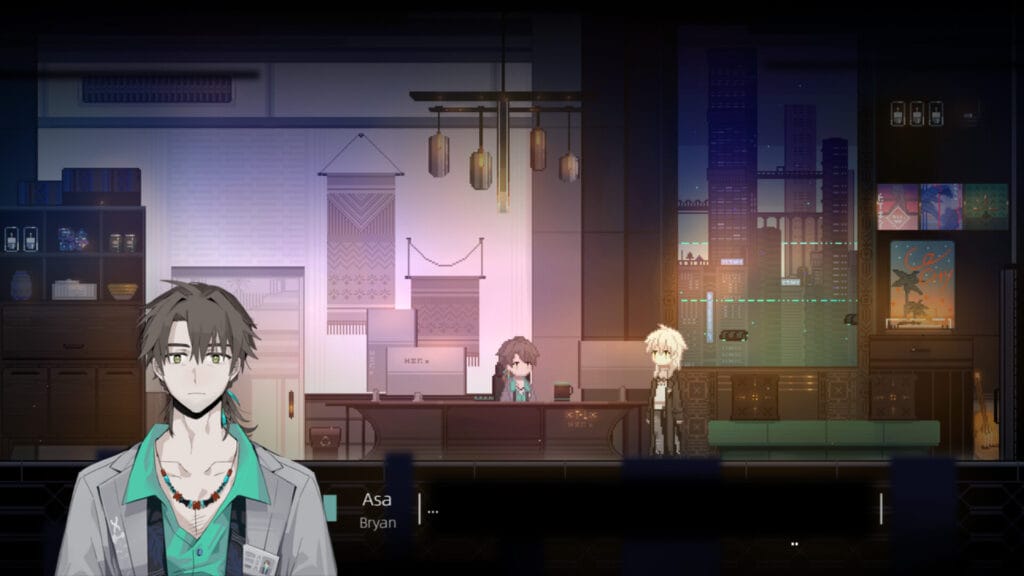
Some supporting characters are less fully explored than others, but the core cast leaves a strong impression. The game allows emotional moments to breathe, trusting the player to absorb them rather than signalling how they should feel.
Thematically, Nobody Nowhere consistently engages with questions of consciousness, identity, and agency. These ideas are embedded into dialogue, environmental text, and story progression rather than delivered through overt commentary. Occasional flashbacks and shifts in perspective provide context and texture, deepening the narrative without disrupting its clarity.
Pixel Art and Presentation: Expressive and Intentional
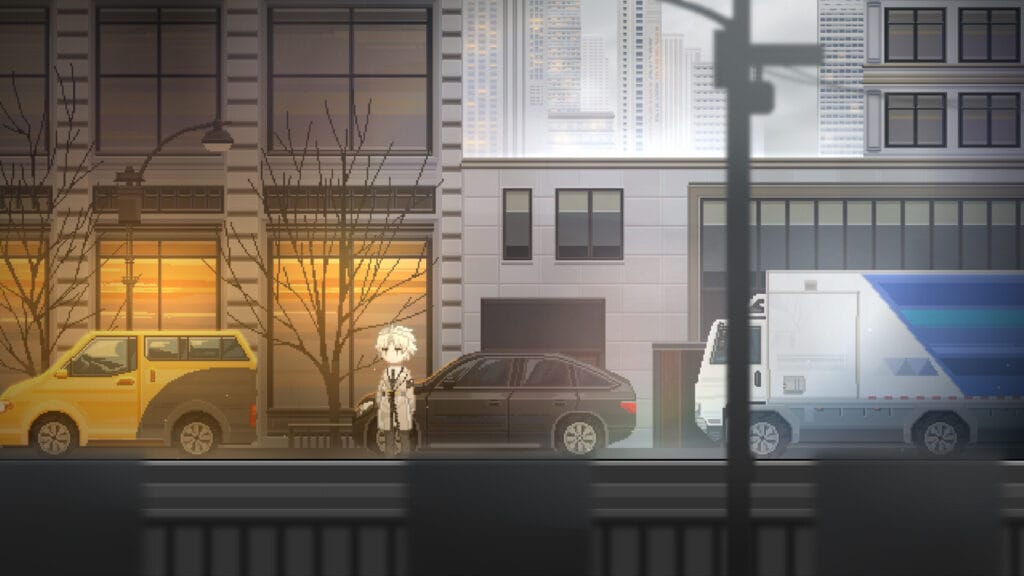
Visually, Nobody Nowhere employs pixel art with purpose. This is not a retro affectation for its own sake, but a cohesive visual language that complements the text-heavy narrative and understated sci-fi tone. Characters and environments are rendered with expressive simplicity, allowing subtle animation and framing to convey emotion without excess detail.
Sprite movement, even in restrained idle animations, contributes to a sense of life within scenes. Lighting, colour, and composition reinforce mood, whether in sterile research corridors, quiet exterior locations, or spaces tied to moments of reflection. The result is a presentation that feels cohesive and intentional throughout.
Narrative Pacing: Fluid Without Choice Overload
The game’s pacing benefits directly from its linear structure. Dialogue, exploration, and movement are distributed with care, giving each scene time to land before advancing the story. While player agency is limited, the experience never feels rushed or stagnant.
Short exploratory segments and light interaction are interspersed between dialogue sequences, grounding the narrative in physical space without distracting from it. This creates a rhythm that feels cinematic, moving from scene to reflection to transition, while avoiding the rigidity often associated with fully on-rails storytelling.
The balance ensures that narrative revelations feel earned rather than imposed, a quality frequently highlighted by players and critics alike.
Audio and Sound: Subtle and Supportive
Audio design in Nobody Nowhere is understated but effective. Music appears at key moments to reinforce tone and emotion without overpowering the text. The soundtrack is used sparingly, but when it surfaces, it heightens the impact of pivotal scenes.
Ambient sound plays an equally important role. Footsteps, environmental noise, and quiet transitions help fill the spaces between narrative beats, reinforcing immersion while keeping focus squarely on the story.
This is a deliberate choice rather than a limitation. By keeping interaction minimal, the game preserves narrative flow and avoids unnecessary interruption. The experience aligns more closely with a kinetic novel or interactive film than with a traditional genre hybrid.
Short Runtime, Lasting Impact
Nobody Nowhere is a short experience, typically completed in a few hours. This brevity suits its focused narrative design. The game concludes before repetition sets in, and nearly every scene contributes directly to story or theme.
Shorter runtimes often risk feeling insubstantial, but that is not the case here. The narrative’s emotional and thematic resonance lingers beyond its length, demonstrating the effectiveness of concise, disciplined storytelling.
Final Verdict
Final Score: 4.2/5
Nobody Nowhere is a confident, carefully constructed narrative adventure that blends pixel art, science fiction, and text-driven storytelling into a cohesive whole. Its linear structure, expressive presentation, and controlled pacing result in an experience that feels intimate yet complete, despite its modest runtime.
It may not appeal to players seeking deep mechanical systems or branching narrative paths, but as a narrative-first journey focused on mood, character, and thematic clarity, it stands among the stronger indie story experiences on PC in 2025.
This review is based on the PC (Steam) version, with the code provided by the game’s publishers.
About the Author