Avinash Rohra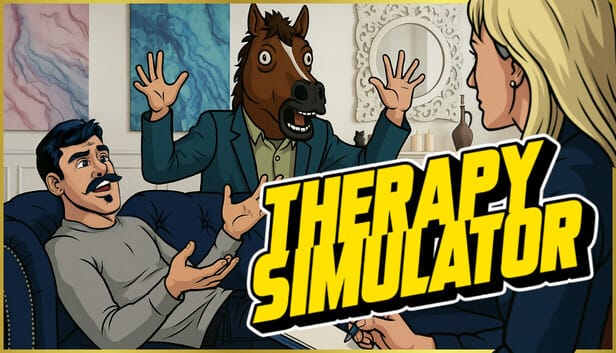
There is an inherent gravity to a game that places conversation and emotional exchange at its center. Therapy Simulator, played on PC, positions itself as a quiet, dialogue-led experience where progress is shaped through words rather than action. Over the course of the experience, that focus becomes both its defining trait and its primary limitation. What emerges is a work that often feels careful to a fault, earnest in tone, restrained in presentation, and hesitant to push its ideas far enough to leave a lasting impression.
This is a game that unfolds slowly and asks the player to pay attention, but it does so without always providing the clarity or feedback needed to sustain engagement. The result is an experience that feels thoughtful in outline, yet underdeveloped in execution.
An experience driven by conversation
At its core, Therapy Simulator is structured around dialogue. Sessions progress through exchanges that ask the player to select responses, interpret emotional cues, and move conversations forward. There are no reflex-driven challenges or traditional fail states to contend with; advancement is tied almost entirely to navigating these interactions.
In practice, this structure creates a sense of participation that can feel shallow. Dialogue options are frequently close in tone and phrasing, making it difficult to understand how one choice meaningfully differs from another. Rather than feeling like distinct paths, responses often register as variations on the same sentiment. This blurs the line between decision-making and simple progression, leaving the player unsure of how their input is shaping the experience.
Ambiguity can be a powerful tool, but here it often lacks support. Without clearer contextual cues or observable shifts in response, conversations begin to feel interchangeable, reducing the impact of each choice.
A restrained tone that rarely evolves
The overall tone of Therapy Simulator remains consistently subdued. Conversations are serious, measured, and deliberately paced, with little variation in emotional intensity. While this restraint avoids melodrama, it also limits contrast. Moments that hint at vulnerability or insight often pass without escalation, making it difficult for scenes to build momentum.
Characters speak at length, yet their voices tend to blend together. Without sharper distinctions in perspective or delivery, individual sessions can feel repetitive. Topics are raised, acknowledged, and then moved past with minimal exploration, creating the impression of depth without the time or specificity needed to make it resonate.
The writing conveys care, but it frequently feels tentative. Exchanges often read as incomplete thoughts rather than fully formed conversations, contributing to a sense of emotional distance rather than intimacy.
Systems that struggle to reinforce theme
Because interaction is so limited in scope, the systems supporting it carry significant weight. Here, Therapy Simulator falters. The game provides little feedback on how conversations are unfolding beyond allowing them to continue. Consequences, if present, are subtle to the point of being indistinguishable.
This lack of responsiveness makes it difficult to invest emotionally. Selecting dialogue options feels less like shaping an exchange and more like unlocking the next segment of text. Over time, the act of choosing loses its significance, turning interaction into routine rather than engagement.
Pacing further compounds this issue. Sessions can linger without developing, and transitions between scenes lack a sense of progression. The game asks for patience, but it does not consistently reward it with new insight or perspective.
Minimal presentation, limited impact
Visually, Therapy Simulator adopts a minimalist approach. Environments are clean and functional, with little variation between spaces. While this keeps attention on dialogue, it also reinforces a sense of sameness. Locations rarely reflect the emotional content of the conversations taking place, which weakens immersion.
Audio design follows a similarly restrained path. Silence is common, and when sound is present, it tends to remain unobtrusive. This quiet can occasionally support reflection, but more often it feels like an absence rather than a deliberate choice. Music and sound cues do little to distinguish scenes or underline shifts in mood, leaving the experience emotionally flat.
The combined effect is a presentation that maintains distance. Rather than drawing the player inward, it often feels observational, as though watching conversations unfold from the outside.
Care without commitment
One of the most noticeable aspects of Therapy Simulator is its cautious handling of sensitive topics. Conversations avoid extremes, rarely venturing into discomfort or confrontation. While this prevents missteps, it also limits impact. Issues are approached abstractly, discussed briefly, and then set aside, giving the experience a muted quality.
By keeping everything at arm’s length, the game sidesteps complexity. Emotional subjects are acknowledged, but seldom explored in depth. This restraint may appeal to players seeking a very gentle experience, but it also means the game struggles to offer insight beyond surface-level observation.
Where the experience falls short
Across its runtime, Therapy Simulator often feels like an outline rather than a finished statement. The structure suggests an interest in reflection and communication, but the mechanics do not consistently support that interest. Writing, interaction, and presentation rarely align strongly enough to reinforce one another.
As a result, the player is frequently asked to invest emotionally without being given sufficient reason to do so. The experience moves forward, but it does not deepen. What remains is a sequence of conversations that gesture toward significance without fully committing to it.
Final thoughts
Therapy Simulator is a subdued, conversation-focused experience that approaches its subject matter with visible care, but limited confidence. Its reliance on dialogue is not matched by sufficient mechanical or narrative reinforcement to make those exchanges feel impactful. Over time, restraint turns into hesitation, and sensitivity becomes a barrier rather than a strength.
After completing it on PC, the impression left is not frustration, but detachment. There are ideas here worth exploring, but they remain largely unformed.
Final Score: 2.8 / 5
A quiet, well-meaning experience that struggles to translate its focus on emotional exchange into engaging interaction. Therapy Simulator may appeal to players seeking something extremely subdued and abstract, but it lacks the clarity and depth needed to make its conversations truly matter.
This review is based on the PC (Steam) version, with the code provided by the game’s publishers.
About the Author