Avinash Rohra
I have always thought the best vampire stories begin after the interesting part is supposed to be over. The secret has already been exposed, the first corpse has been explained away, the pitchforks have gone back into the shed, and everyone is left to figure out what happens when the monsters are no longer hiding under the bed.
That is the strange and surprisingly ambitious place where Nighthawks begins.
You died six months ago, came back as a vampire, and arrived in Cradlebridge looking for Elijah Morrow, another vampire connected to your new existence. The world already knows what you are. There is no masquerade left to maintain and no grand revelation waiting around the corner. You simply have to work out how to live with what you have become.
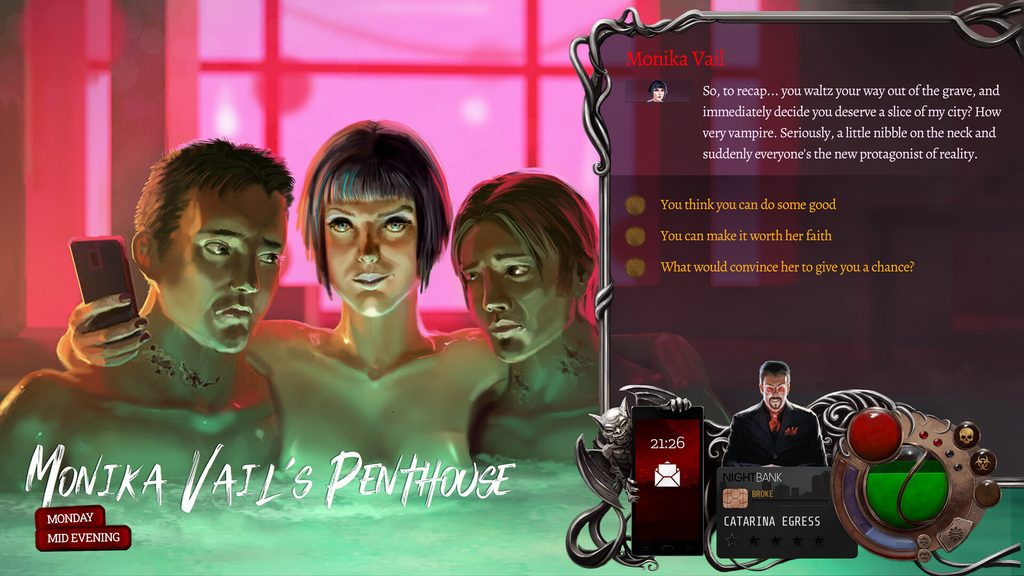
I spent considerably longer with Nighthawks than I initially expected to, partly because there is an almost unreasonable amount of game here and partly because I kept finding another conversation, another character, or another decision that made me reconsider something I thought I had already understood. The frequently mentioned figure of more than 800,000 words sounds like a piece of trivia until you actually play the game and realise what that volume means in practice. Conversations branch. Characters remember things. Decisions can close one door while quietly opening another somewhere else, sometimes much later than you expect.
That density is also the first warning I would give anyone considering Nighthawks: this is a game that expects you to read. A lot.
I went in wondering whether the sheer amount of writing would eventually become exhausting, whether the vampire premise would spend too much time admiring its own cleverness, and whether the deliberately old-fashioned presentation would make the whole thing feel more like a historical curiosity than a modern RPG.
Instead, somewhere along the way, Nighthawks became one of those games I found myself thinking about after I had stopped playing it.
The Masquerade Is Over. Good.
The easiest thing about Nighthawks to misunderstand is its premise. This is not really a game about becoming an incredibly powerful vampire. It is about what happens when being a vampire becomes an awkward fact of everyday life.
Cradlebridge is attempting to accommodate a population that, until relatively recently, would have been considered folklore. Vampires need blood, while humans have perfectly understandable reasons for not wanting to volunteer themselves as a buffet. Politicians, businesses, neighbours and other vampires all have their own ideas about what coexistence should look like. You are caught somewhere in the middle, trying to establish yourself while figuring out what kind of vampire you actually want to be.
That gives the familiar vampire fantasy an uncomfortable little twist. You have supernatural abilities, but you are rarely using them simply to tear through an army of disposable enemies. Mesmerism can help manipulate conversations. Natural Dominion gives you influence over animals. Tenebrous Form allows you to make use of the supernatural nature of your character in ways that can open up different solutions to problems.
Your powers are therefore less about making you unstoppable and more about changing the kinds of problems you can solve.
That distinction matters because Nighthawks understands something many vampire games forget: immortality does not automatically make a character interesting. What you do with it does.
The game is much more interested in the social consequences of being a vampire than in letting you cosplay as an invincible creature of the night. Blood is a resource. Relationships matter. Your decisions affect how people perceive you. The basic structure continually pushes you toward questions about what you are willing to sacrifice for convenience, survival or ambition.
It is an unusually good foundation for a role-playing game because the central fantasy is not simply, “I am a vampire.” It is, “I am a vampire, and now I have to decide what that actually means.”
Your Vampire Powers Are Better at Causing Trouble Than Killing People
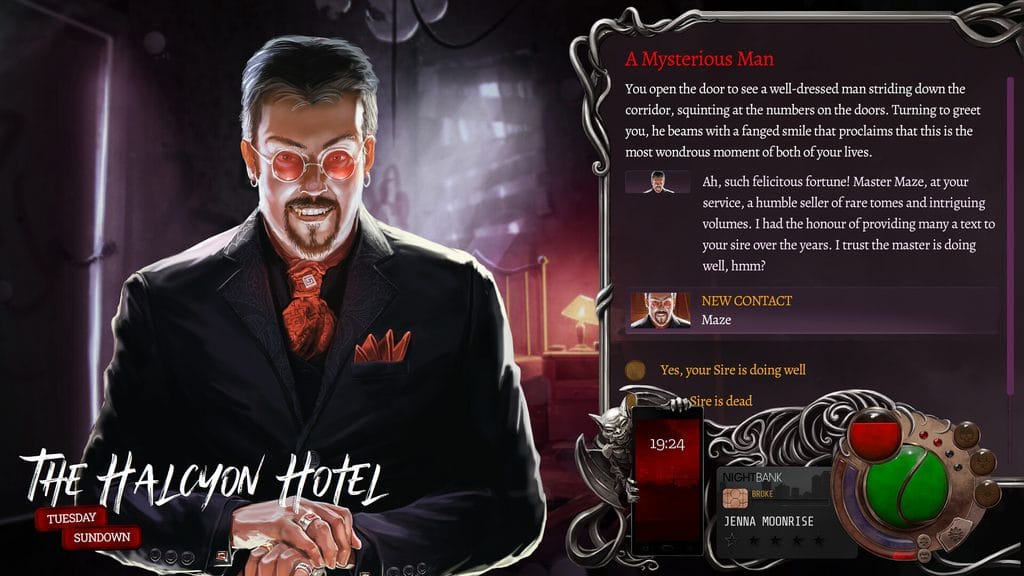
This is where Nighthawks’ design begins to come together.
At its core, this is a choice-driven RPG in which exploration, dialogue, traits, resources and supernatural abilities constantly feed into one another. You move around Cradlebridge by selecting locations on the map, and what happens when you arrive depends heavily on your abilities, relationships and previous decisions. As you become more familiar with the city, the map starts to feel less like a conventional collection of locations and more like a representation of the life you are gradually building there.
Combat follows much the same philosophy, although it is not the game’s strongest system. Nighthawks certainly has fights, but it does not turn them into elaborate action sequences or traditional turn-based encounters. Your abilities, traits, resources and choices determine how effectively you navigate dangerous situations.
That works thematically, although players coming to Nighthawks expecting a deeper combat system may find themselves wanting more. There is something refreshing about violence being one possible answer rather than the default solution to every RPG problem, but the combat simply does not have the mechanical depth of the writing and character systems.
The game is far more interested in why you ended up fighting, what led you there and what happens afterward than in making the fight itself the memorable part.
I actually came to appreciate that restraint. Nighthawks refuses to turn every problem into a combat encounter simply because it happens to be an RPG. Sometimes the clever answer is to manipulate someone. Sometimes it is to exploit a supernatural ability. Sometimes the best option is to accept a disadvantage because the alternative is worse. And sometimes, inevitably, you fight.
The more interesting mechanical pressure comes from time and resources. Night does not last forever, and your activities move you toward sunrise. Blood management and other character resources give your decisions another layer of consideration. Early on, this creates exactly the sort of pressure I want from a vampire RPG. Your nocturnal existence has rules, and those rules have consequences.
The pacing is not always as successful. Some deadlines are generous enough that the pressure can gradually disappear, and advancing time can start feeling more like something to keep track of than a meaningful strategic concern. The underlying idea is excellent, but its implementation is occasionally uneven.
What remains compelling is the way these systems encourage experimentation. Traits can improve through use, companions bring their own strengths and complications, and locations become more useful as you understand how the city works. Some of the best moments come when a problem that initially looks as though it has one obvious solution turns out to have three or four.
That, more than any supernatural ability, is Nighthawks’ real power fantasy.
This Is a Lot of Game for a Lot of Readers
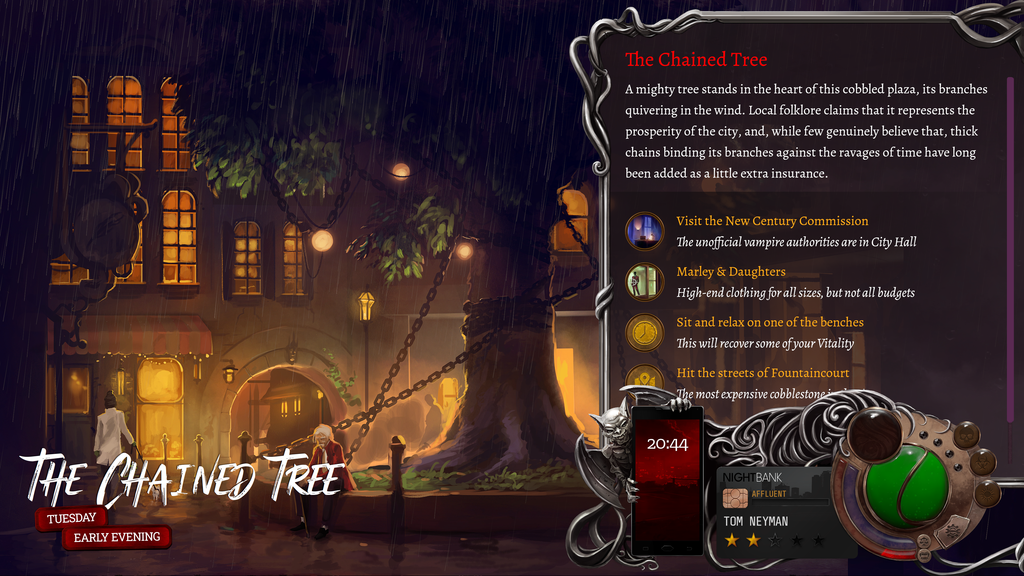
There is no getting around the writing.
More than 800,000 words is an absurd amount of text for any game, but Nighthawks does not simply pile prose on top of itself and mistake quantity for depth. The writing is the foundation on which much of the game is built. Characters have space to develop. Conversations can wander somewhere unexpected. Choices establish relationships, close doors, open others and occasionally force you to reconsider what you thought you knew about someone.
The ten recruitable companions are particularly important because they stop the game from becoming an endless procession of interchangeable quest dispensers. Madame Lux, Maze, Domino and Agatha all bring different perspectives to the vampire society the game is constructing, and spending time with them gives the nightclub and the wider city considerably more personality.
You can also see where some of Nighthawks’ influences come from. There are traces of classic computer RPGs, the text-heavy exploration associated with Fallen London, and the narrative-adventure tradition associated with Wadjet Eye Games. But Nighthawks is not simply trying to reproduce any of those experiences. It borrows their vocabulary and uses it to tell a story specifically interested in vampires, identity and social survival.
The obvious downside is that this much writing will test the patience of anyone who does not particularly enjoy reading in games.
There were stretches when I wanted Nighthawks to get to the point. There were moments when the amount of information being delivered made it harder to maintain the same level of attention. This is not something you casually play while half-watching a television show. The game expects you to remember people, places and conversations, and it rewards you when you do.
For the right player, that is exactly the appeal.
For everyone else, the 800,000-word figure is less a selling point than a warning label.
Ben Chandler Gives 800,000 Words Somewhere to Live
Thankfully, Nighthawks has a visual identity strong enough to prevent all that text from making the game feel visually anonymous.
Ben Chandler’s pixel art gives Cradlebridge an appropriately strange personality. The city does not feel like a generic gothic backdrop assembled from the usual collection of vampire imagery. There is grime and theatricality in the environments, but also enough personality to make the setting feel lived in. That suits a game in which social performance can be just as important as supernatural horror.
The pixel-art presentation helps enormously because Nighthawks does not need to chase photorealism. Characters and locations can be exaggerated without becoming ridiculous, giving the whole thing the feeling of a graphic novel or illustrated adventure rather than another modern RPG trying to convince you that every brick needs to look real.
Thomas Regin’s music plays an equally important role in establishing the game’s tone. Nighthawks is not pure horror, and the soundtrack understands that. There is melancholy, but there is also humour, loneliness, ambition and the occasional strange feeling of watching deeply unusual people attempt to construct something resembling a normal life.
That tonal balance is important. The game can be funny without undermining its darker moments, and unsettling without making every scene miserable.
The Nightclub Is Where Nighthawks’ Ideas Finally Click
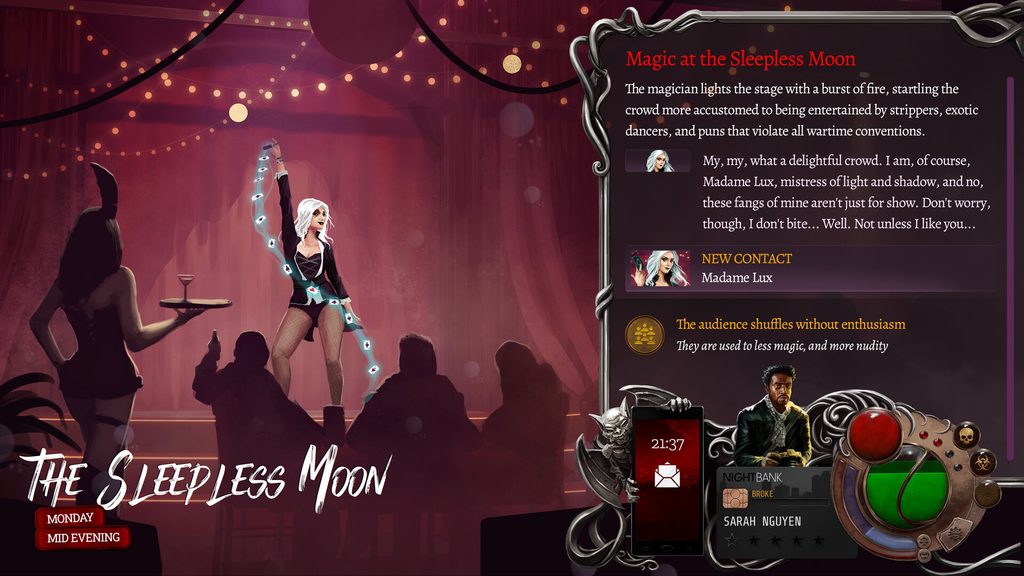
The nightclub is arguably the game’s smartest structural decision.
You take over a failing club and gradually turn it into something of your own, using it to recruit people, build relationships and establish your position in Cradlebridge. It is simultaneously a business, a social space and a reflection of the character you are creating.
That makes it much more interesting than the usual RPG headquarters. Your vampire does not simply return there between missions to recover and organise their inventory. The club becomes a physical representation of your choices and ambitions.
More importantly, it gives Nighthawks a metaphor that neatly ties the rest of the game together.
Vampires are trying to build a society. You are trying to build a place within that society. Everyone has an opinion about what that society should look like, and nobody completely agrees on how much compromise is acceptable.
Some of the game’s strongest moments come from the collision between personal ambition and social responsibility. You can pursue power. You can build relationships. You can attempt to create something more humane. None of these approaches is presented as entirely clean or consequence-free.
That moral messiness is what elevates Nighthawks beyond the novelty of its premise. The vampire setting is interesting, but the questions it allows the game to ask are what make it stick.
A Messy Launch, Then a Quick Fix
The launch itself was considerably messier than the game deserved.
Before release, Steam mistakenly classified Nighthawks as Adults Only, causing the game to be hidden from searches and making it unavailable in some territories. Valve reversed the classification before launch, but the incident created an entirely unnecessary cloud around a game that was already arriving with a relatively niche audience.
According to Dave Gilbert, the situation ultimately became a “net positive,” with the game’s wishlists reportedly doubling overnight. That is his account rather than an independently verified figure, but there is something admirable about the team’s ability to turn an unfortunate situation into momentum.
The developers also moved quickly once the game was out. Patch 1.1 addressed several specific problems, including the awkwardness of sewer exploration without Agatha, sewer fast travel, an issue involving Madame Lux’s early-game blood reward and Sleepless Moon map unlock, and a potential softlock involving the Sucker Bet quest. A larger collection of typo, consistency and minor visual fixes was also planned.
That responsiveness matters more in a game like Nighthawks than it might in a conventional action title. When your experience depends on reading, navigating choices and keeping track of interconnected systems, a small progression problem can become disproportionately irritating. One broken link in that chain can interrupt the rhythm of an otherwise absorbing session.
The good news is that the developers have clearly been paying attention.
Final Verdict: The Vampire RPG I Didn’t Expect to Keep Thinking About
Score: 4.5/5
I came into Nighthawks expecting to admire the idea more than the execution. The concept was clever, the writing pedigree was obvious, and the enormous word count was impressive as a piece of trivia. I was much less certain that all that ambition would actually hold together as an RPG. Not perfectly, and certainly not always gracefully, but often in ways that caught me completely off guard. There are more polished RPGs.
There are vampire games with deeper combat systems. There are games with much more immediately impressive production values. Nighthawks is not really trying to compete with those things. Its strength comes from understanding that the most interesting part of being a vampire is not necessarily biting someone’s neck. It is deciding what kind of person you become once the world already knows what you are.
That is why the game’s best mechanics are conversations, relationships, resources and consequences. Combat exists and serves its purpose, but it deliberately sits away from the centre of the experience. The real battles are social, emotional and sometimes ideological.
After spending so much time with it, I came away with a greater appreciation for just how difficult this kind of RPG is to make. It would have been considerably easier to build another vampire power fantasy. Nighthawks instead asks what happens when that fantasy has to survive contact with ordinary life.
That is a much stranger question.Thankfully, it is also a much more interesting one.
Nighthawks is a deeply ambitious vampire RPG that occasionally struggles beneath the weight of its own ideas, but its writing, characters, systems and unusual approach to the genre make those ambitions worthwhile. If you want an action-heavy vampire game, this probably is not the one to sink your teeth into. If you want a character-driven RPG where conversations can matter as much as combat, where relationships can be as consequential as supernatural abilities, and where being a vampire is as much a social problem as a supernatural gift, this deserves your attention. The masquerade is over.
Nighthawks is interested in what happens the morning after.
This review of Nighthawks is based on the PC version, with code provided by the publisher.
About The Author