Avinash Rohra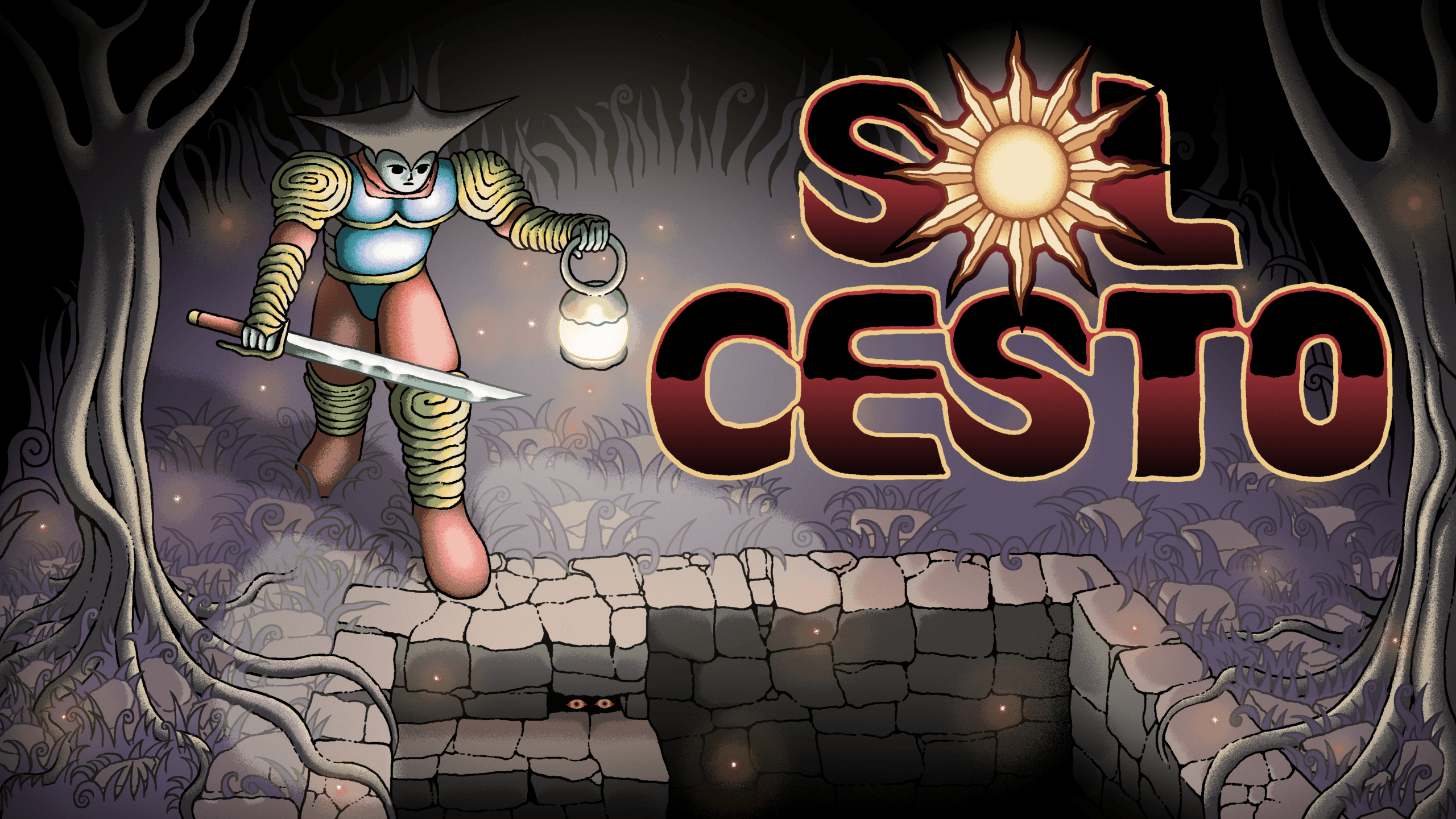
I spent close to 14 hours inside Sol Cesto before I felt confident enough to even begin writing this. That number alone doesn’t quite capture it. This is one of those games that resists surface-level understanding. My first three hours were messy, almost resentful. By hour six, I had a notebook open beside me, scribbling probabilities and outcomes like I was studying for an exam I hadn’t signed up for. By hour ten, something shifted. Not just mechanically, but mentally.
I scrapped my first draft entirely. It read like a complaint. The second draft leaned too heavily into explaining systems without capturing what they felt like. This version is the third, written after I went back for “just a few more runs” that turned into another late night.
That’s the thing about Sol Cesto. It demands patience not just in how you play it, but in how you process it. It’s deceptively minimal on the surface, almost hostile in how little it explains. But beneath that is a design that only reveals itself if you’re willing to sit with it, fail repeatedly, and pay attention.
This isn’t a game you review after a weekend. It’s one you wrestle with until it starts speaking your language.
The Doubt Was Immediate – and Justified
Let’s be honest about first impressions, because they matter. Sol Cesto does not make a strong one.
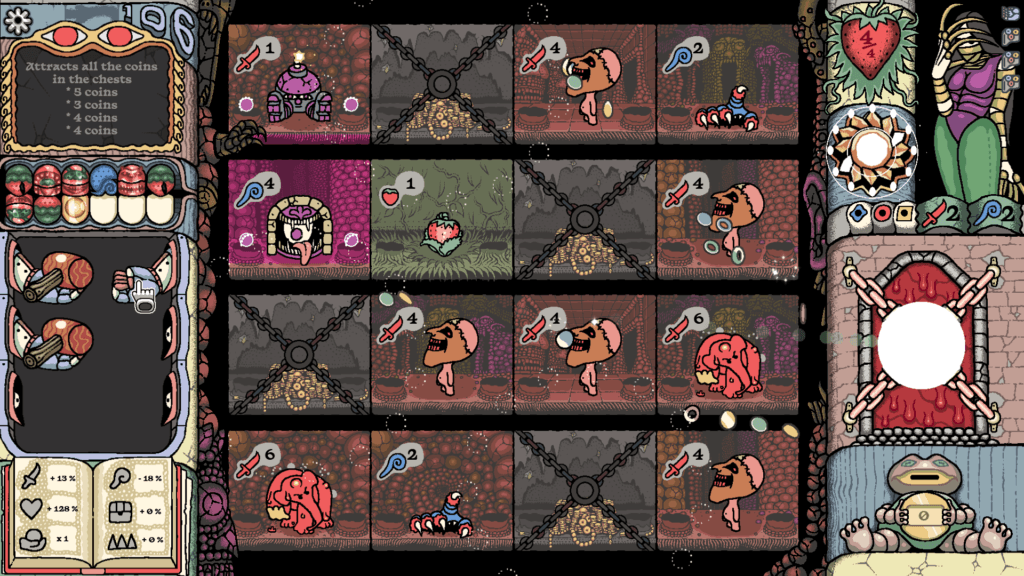
A 4×4 grid. Pick a row. Land randomly. Resolve outcome. Repeat.
That pitch alone sounds like a prototype, not a finished game. It carries the whiff of a gimmick-something closer to a mobile time-killer than a fully realized roguelite. And early on, it reinforces that skepticism. You make a choice, the game rolls the dice, and you take damage anyway. You die. Restart. Repeat. It feels arbitrary, even unfair.
The randomness is front-loaded, and that’s dangerous. Because without context, it reads as a lack of control. Your hero doesn’t move with intention. You don’t choose tiles. You choose rows, and then watch the outcome unfold. It creates distance between player and action, which in most games would be a fatal flaw.
Even aesthetically, while striking, it doesn’t immediately communicate clarity. The hand-drawn, Mesoamerican-inspired visuals are dense, almost overwhelming at first glance. You’re trying to understand mechanics while parsing visual noise. It’s not unreadable, but it doesn’t hold your hand either.
And then there’s the narrative-or lack of one. The premise is simple: the sun is gone, descend into darkness to restore it. That’s it. No exposition dumps, no character-driven arcs pulling you forward. If you come in expecting something like Hades or Dead Cells with strong narrative hooks, you’ll feel that absence immediately.
All of this creates a very real barrier. It’s easy to bounce off Sol Cesto in the first hour and dismiss it as shallow, overly random, or simply not worth the effort.
And for a while, I almost did.
The Moment It Clicks
There’s a specific moment where Sol Cesto reveals itself, and when it does, it reframes everything that came before.
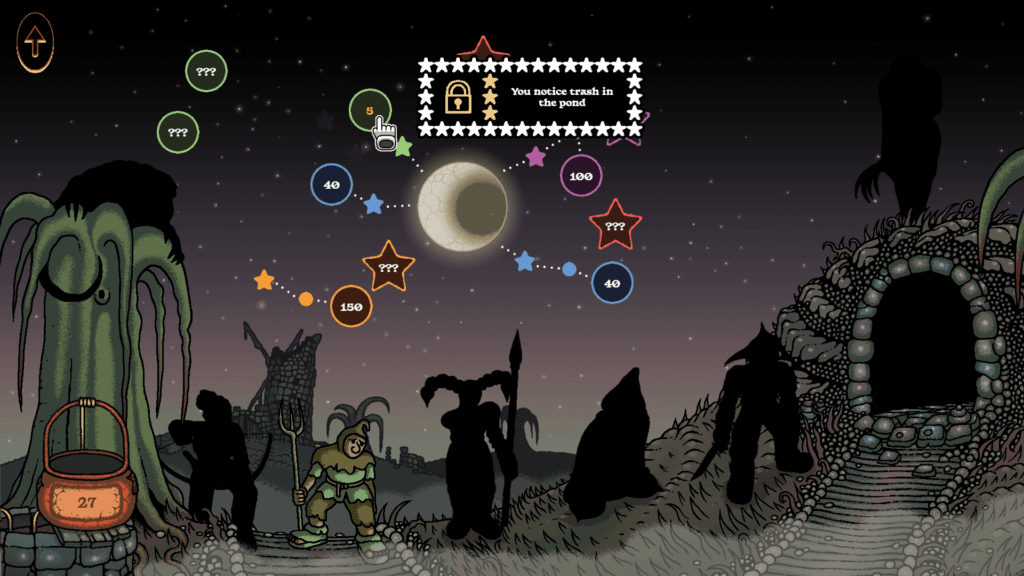
For me, it happened during a run where I was low on health, staring at a grid that looked like a death sentence. Three enemy tiles, one treasure, one heal buried somewhere uncertain. Instead of guessing, I paused. I looked at the probability indicators. I considered how previous moves had shifted the odds. I remembered the tooth I had equipped that skewed outcomes toward higher risk, higher reward.
I didn’t pick the “safest” row. I picked the most calculated one.
And it worked.
That’s when it became clear: Sol Cesto isn’t random. It’s probabilistic. And that distinction is everything.
The game is constantly feeding you information. Every tile, every outcome, every adjustment in odds is part of a system that you can learn, manipulate, and eventually master. The randomness isn’t there to undermine you. It’s there to force you into a different kind of thinking-one that’s less about control and more about influence.
The teeth system is where this really deepens. These modifiers don’t just tweak numbers; they reshape the entire risk landscape. You might increase your chances of finding treasure, but at the cost of encountering stronger enemies. You’re not eliminating randomness-you’re bending it in your favor, at a price.
This is where Sol Cesto separates itself from its peers. It turns RNG into a strategic layer rather than a frustration point. You’re not fighting the system. You’re negotiating with it.
And once you understand that, the game transforms from a frustrating exercise in luck into something far more compelling-a tactical puzzle where every decision carries weight.
A Story Told Through Systems
Narratively, Sol Cesto is restrained to the point of near absence. But that doesn’t mean it’s empty.
The premise-descending into a sunless world to restore light-is less a story and more a thematic foundation. The real narrative emerges from your interaction with the systems. Each run becomes a micro-story of risk, failure, adaptation, and eventual mastery.
The addition of multiple characters with unique endings in the 1.0 release adds texture, but these aren’t deeply written arcs. They function more as reflections of your journey than drivers of it. You don’t play for the story. You play for the experience, and the story exists as a quiet echo of that.
What Sol Cesto does well is thematic cohesion. Everything-mechanics, art, audio-feeds into the idea of navigating darkness without certainty. You are never fully in control. You are never fully safe. But you are always learning.
There’s a subtle philosophical undercurrent here about agency within constraint. About making the best decision you can with incomplete information. About accepting that even the right choice can lead to the wrong outcome-and playing anyway.
It’s not overt. It doesn’t announce itself. But it’s there, embedded in every system.
Systems That Feed Each Other
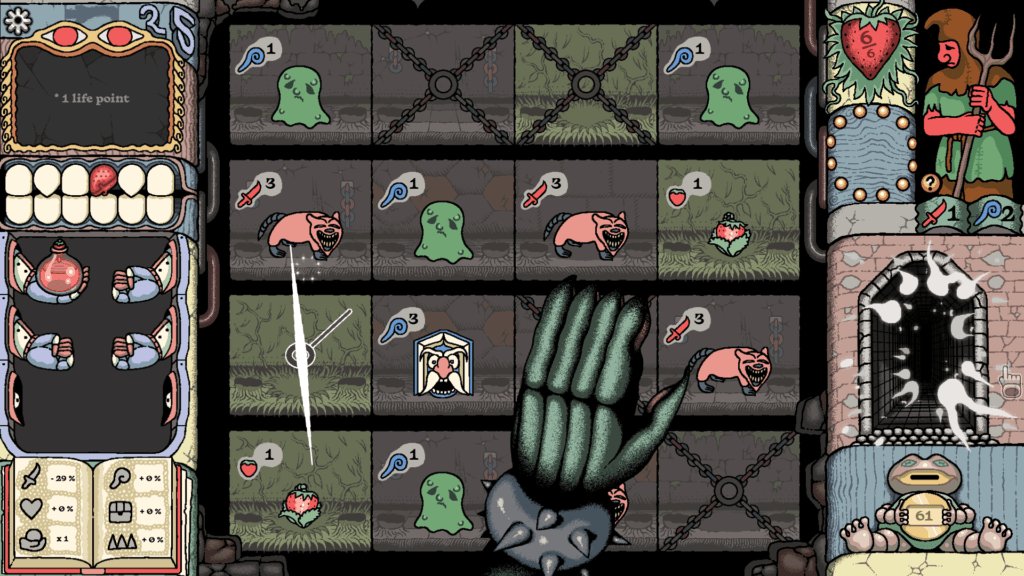
Mechanically, Sol Cesto is deceptively dense.
The core loop-selecting rows on a 4×4 grid-remains consistent throughout, but the complexity comes from how systems intersect. Probability shifts dynamically based on your actions. Teeth modify those probabilities further. Inventory management forces trade-offs between immediate survival and long-term gain.
Combat, while simple on paper, carries weight because of how it ties into everything else. You don’t “fight” enemies in the traditional sense. You resolve them. And that resolution is determined by stats, which are influenced by your choices, your items, and your willingness to take risks earlier in the run.
The meta-progression layer adds another dimension. Banking gold to unlock upgrades and characters creates a long-term arc that softens the brutality of individual runs. But importantly, it doesn’t trivialize the core challenge. You’re still at the mercy of the grid. You’re just slightly better equipped to navigate it.
What’s impressive is how cohesive it all feels. Nothing exists in isolation. Every system feeds into another, creating a loop that is both tight and surprisingly flexible.
The downside is that once you’ve seen everything, the game doesn’t evolve dramatically. New biomes and bosses add variety, but the fundamental loop remains unchanged. For some, that consistency will feel elegant. For others, it may border on repetitive.
Art That Carries Weight
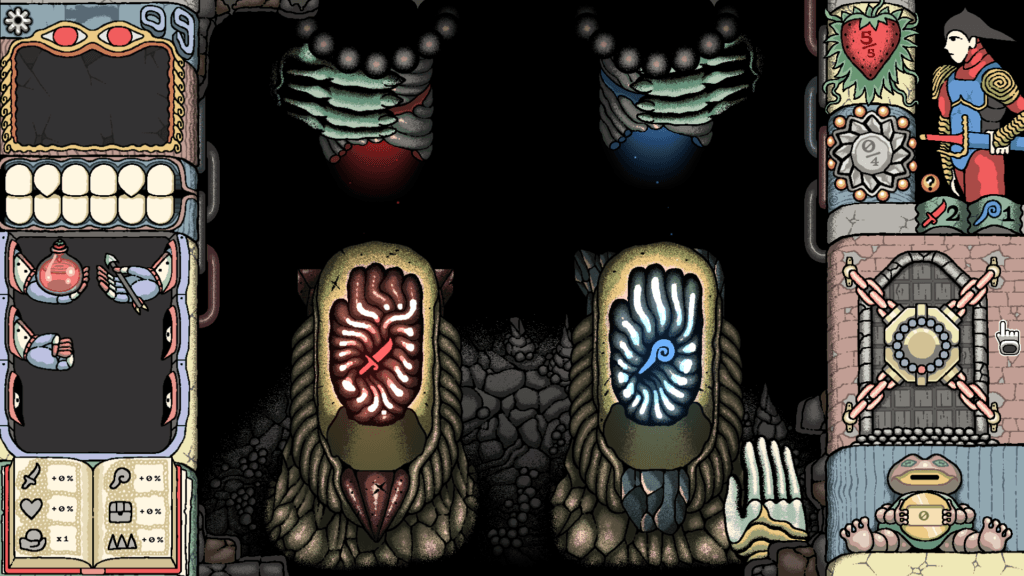
Visually, Sol Cesto is striking in a way that feels deliberate rather than ornamental.
The hand-drawn style, heavily inspired by pre-Columbian and Mesoamerican art, gives the game a distinct identity. It’s not just aesthetic dressing-it reinforces the tone of a world steeped in myth and decay. Creatures feel less like enemies and more like artifacts of a forgotten culture.
Animation is subtle but effective. Tiles ripple. Environments breathe. There’s a constant sense of unease, as if the world itself is alive and watching.
The soundtrack follows a similar philosophy. It’s not there to energize you. It’s there to unsettle you. Sparse instrumentation, ambient textures, and restrained melodies create an atmosphere that’s oppressive without being overwhelming.
Together, the art and audio don’t just complement the gameplay-they frame it. They make every decision feel heavier, every mistake more consequential.
Standing Apart in a Crowded Genre
Roguelites are not a scarce commodity. From Slay the Spire to Into the Breach, the genre has explored probability, strategy, and repetition in countless ways.
What Sol Cesto does differently is its commitment to abstraction. Where others give you direct control-cards to play, units to move-Sol Cesto introduces a layer of indirection. You don’t choose outcomes. You influence them.
This places it somewhere between a strategy game and a gambling system, but with enough transparency to keep it from feeling unfair. It’s closer in spirit to probability puzzles than traditional roguelites.
It doesn’t have the narrative pull of Hades or the mechanical variety of Dead Cells, but it doesn’t need to. Its identity is built around a singular idea, and it executes that idea with precision.
The Runs That Stay With You
Some runs blur together. Others don’t.
I remember one where I leaned heavily into risk, stacking teeth that pushed probabilities into dangerous territory. It was chaotic, almost reckless-and it worked, until it didn’t. A single miscalculation ended it instantly.
And yet, that run felt more meaningful than safer, more controlled ones. Because it was mine. A product of choices, not chance.
That’s where Sol Cesto excels. It creates ownership over outcomes, even when those outcomes are unfavorable. You don’t blame the game. You analyze it. You adjust. You try again.
Technical Execution
On a technical level, Sol Cesto is clean and efficient.
Performance is stable, load times are negligible, and the UI-especially after the 1.0 overhaul-is clear and readable. Information is presented in a way that supports decision-making without overwhelming the player.
There are no major technical flaws to speak of. If anything, the restraint shown here mirrors the design philosophy of the game itself-focused, deliberate, and free of unnecessary excess.
Longevity and Replay Value
Sol Cesto isn’t built for endless play, and that’s not a criticism.
You can see most of what it offers in 6–8 hours, but the depth of its systems encourages experimentation beyond that. Different characters, different teeth combinations, different approaches to risk-all provide reasons to return.
That said, once you’ve mastered the core loop, the sense of discovery diminishes. The game doesn’t reinvent itself in later stages. It refines, rather than expands.
Final Verdict – Trust the Process
Score: 4.5/5
Sol Cesto is a difficult game to recommend casually. It demands patience, attention, and a willingness to engage with systems that don’t immediately reveal themselves.
But if you meet it on its terms, it rewards you with something rare-a game that transforms randomness into strategy, uncertainty into engagement, and failure into understanding.
This is not a game about control. It’s a game about negotiation. With systems, with probabilities, with yourself.
And when it clicks, it doesn’t just work-it sings.
If you’re willing to look past its minimalism and initial opacity, Sol Cesto isn’t just worth playing-it’s worth learning.
About The Author