Strange Brew Review – Running for Your Life, Powered by Bad Coffee Decisions
 Avinash Rohra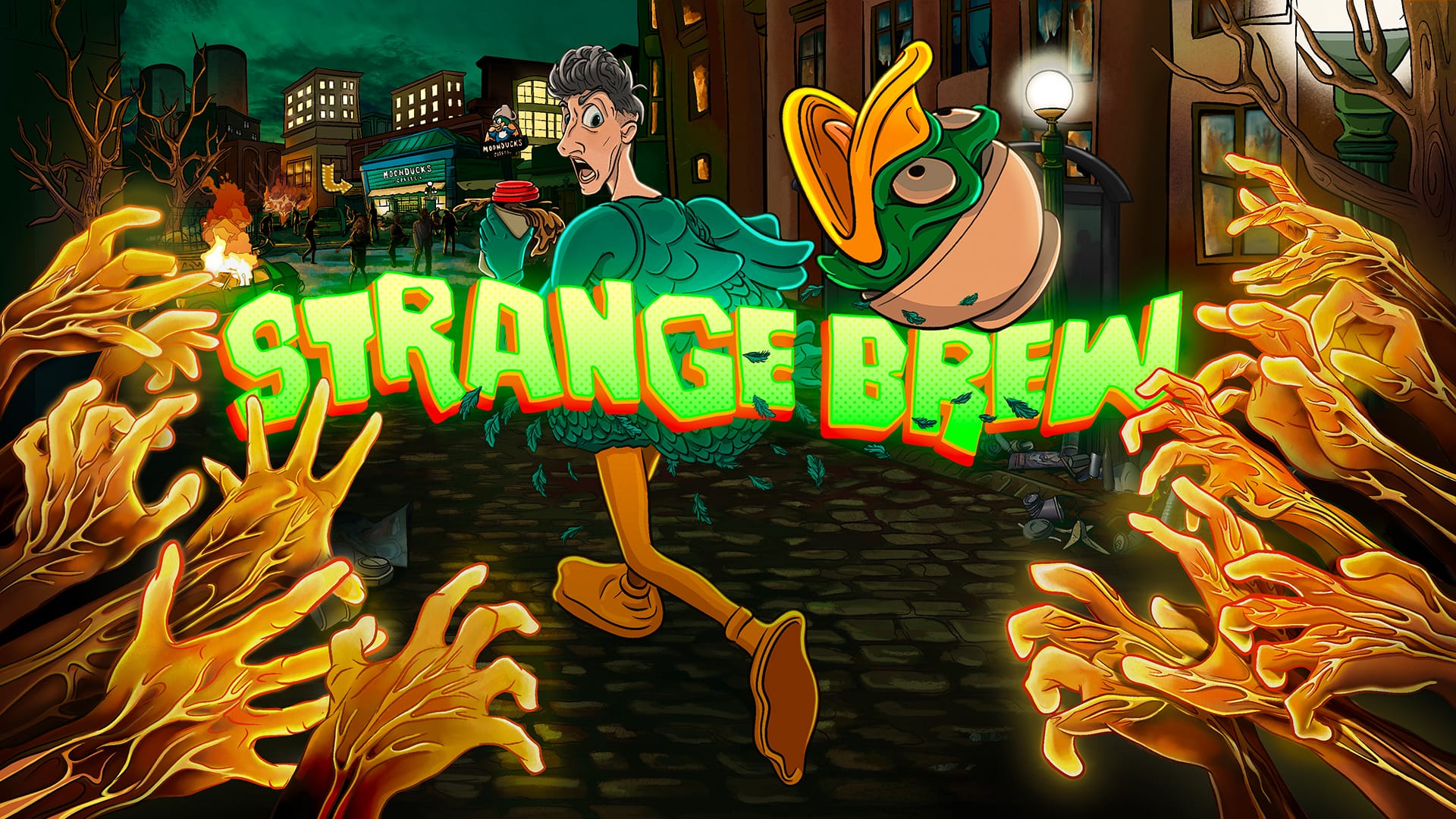
There’s a version of this review I tried to write three times before landing here.
The first was dismissive. The second was overly generous. The third finally felt honest.
Because Strange Brew sits in that awkward, fascinating space where a game is too inventive to ignore, too uneven to fully embrace, and far too committed to its own madness to forget. I spent a good few evenings circling back to it, replaying early levels, testing its rhythm, trying to understand whether what I was feeling was fatigue or familiarity. That distinction matters. One is a design flaw. The other is the natural cost of a focused idea stretched across a full game.
And Strange Brew is nothing if not focused.
Electric Monk Media has built a game around a single sensation: the panic of being chased. Everything else – the duck mascot, the coffee addiction, the absurd corporate apocalypse – is scaffolding around that core. You are always moving, always reacting, always a half-second away from failure. It’s not trying to simulate survival horror. It’s trying to weaponize momentum.
At first, I wasn’t convinced it could sustain that.
Doubt in the First Sip
There’s a thin line between “distinctive” and “one-note,” and Strange Brew walks right up to it in its opening stretch.
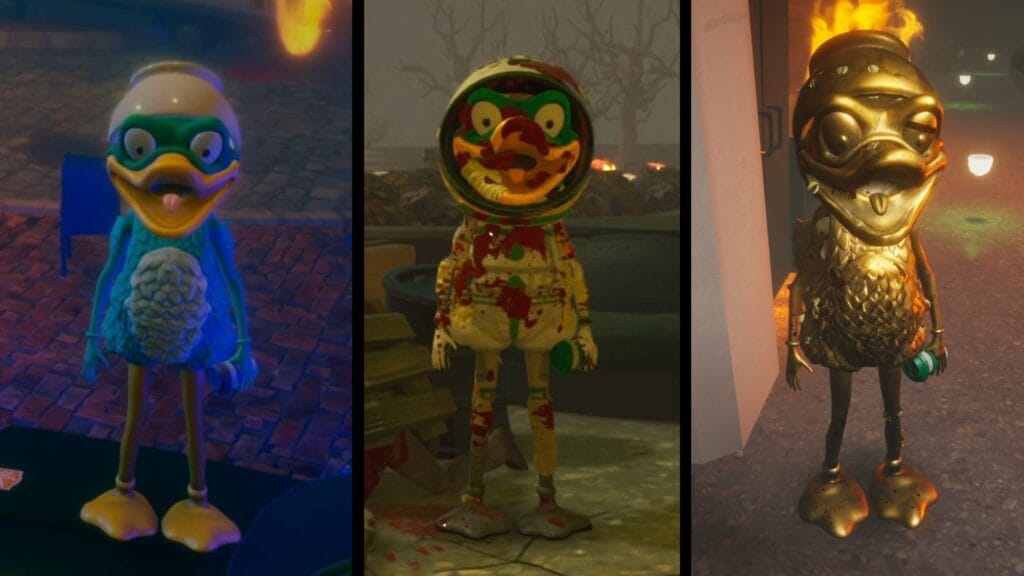
The premise is loud. Intentionally so. You’re playing as Joe, a coffee mascot in a world overrun by zombie-like hordes, triggered by what feels like a corporate experiment gone wrong. It leans hard into camp horror aesthetics, and for a while, it feels like the kind of joke that might wear out its welcome quickly.
The early minutes reinforce that concern. You run. You dodge. You jump. You survive. The mechanics are readable almost immediately, and there’s a moment where you start to wonder if that readability is going to turn into predictability.
That’s usually where games like this falter.
But then Strange Brew starts staging its spaces differently.
When It Clicks, It Really Clicks
There’s a point early on – somewhere between a collapsing industrial stretch and a rooftop sprint – where the game stops feeling like a runner and starts feeling like a performance.
The camera pulls back just enough. The path tightens. The obstacles start arriving with intent rather than randomness. And suddenly, you’re not just reacting – you’re anticipating.
That’s where Strange Brew comes alive.
The bean-throwing mechanic is the quiet hero here. Being able to lure enemies into hazards – power lines, crushing machinery, environmental traps – adds just enough decision-making to elevate the experience. You’re not fighting in a traditional sense, but you are manipulating space. You’re shaping the chaos just enough to survive it.
And when the game layers this into its more elaborate sequences – monorail chases, warehouse interiors, multi-level industrial zones – it finds a rhythm that’s genuinely compelling.
For a while, it feels like it could go much further than it does.
Style Without Apology
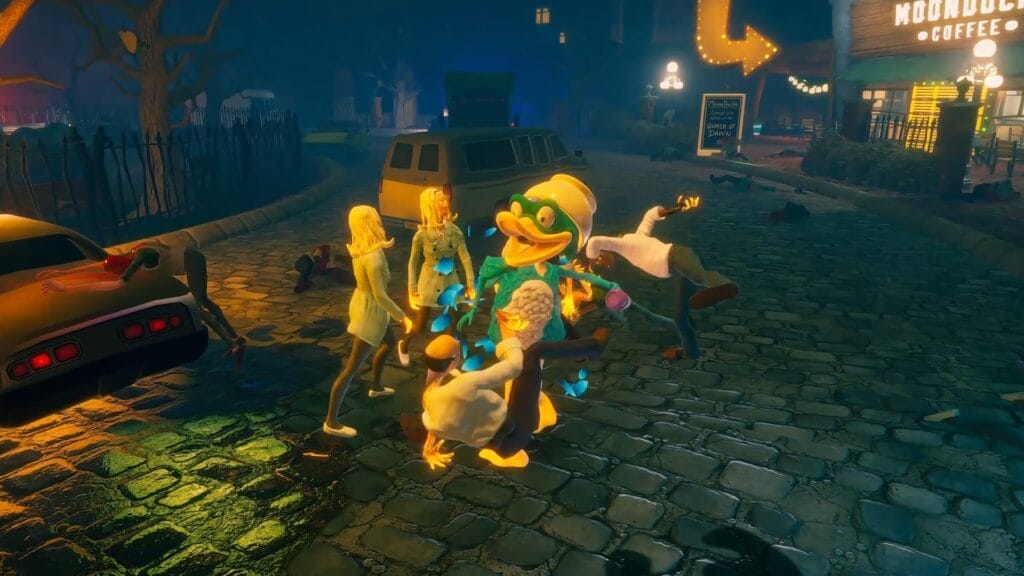
What works consistently is the tone.
Strange Brew never breaks character. It doesn’t wink at you. It doesn’t try to justify itself. The absurdity is treated as normal, and that confidence carries the experience through moments where the mechanics alone might not.
The environments reflect that same conviction. There’s a deliberate grindhouse texture to everything – neon-lit interiors, decaying infrastructure, exaggerated corporate branding. It’s messy, theatrical, and often surprisingly cohesive.
Even small touches, like the black-and-white 1968 Living Dead Mode, speak to a team that understands its influences and leans into them without hesitation.
It’s not just a parody. It’s homage filtered through chaos.
Where the Momentum Slips
But here’s the thing about building a game around constant motion:
Eventually, you start to see the pattern.
By the midpoint, the surprise begins to fade – not because the game runs out of ideas entirely, but because it doesn’t expand on them in meaningful ways. The structure holds. The pacing remains sharp. The set pieces continue to impress on a surface level.
But the underlying loop doesn’t deepen.
You’re still running. Still dodging. Still luring. Still escaping.
And while that loop is solid, it doesn’t evolve enough to sustain the same intensity across the full experience. Some sequences start to blur together, not because they’re poorly designed, but because they rely on the same foundational beats.
This is where Strange Brew settles into its score.
Not disappointing. Not exceptional. Just shy of breaking through.
A Game Built on Moments
What keeps it from slipping further is how well it handles individual sequences.
There are flashes of brilliance throughout. A perfectly timed escape. A chaotic chain reaction that clears a path just as you reach it. A moment where everything clicks into place and the game feels like it’s moving with you rather than against you.
Those moments matter.
They’re what make you restart a level instead of walking away. They’re what carry the experience through its weaker stretches.
And they’re what make Strange Brew memorable, even when it’s not consistently remarkable.
On a technical level, the game holds up well. Performance is stable, inputs feel responsive, and the camera – often a weak point in fast-paced platformers – does a commendable job of maintaining readability during high-pressure sequences.
There’s a level of polish here that suggests confidence, even if the design itself occasionally plateaus.
Pros
- Strong, focused gameplay identity built around chase mechanics
- Memorable set-piece design with cinematic pacing
- Distinct visual style and confident tone
- Simple mechanics elevated by smart environmental interactions
Cons
- Limited mechanical evolution over time
- Repetition becomes noticeable by the midpoint
- Narrative and world-building remain surface-level
Final Verdict
Final Score: 3.8 / 5
Strange Brew is the kind of game that earns respect before it earns love.
It commits to its idea fully, executes it with confidence, and delivers a string of genuinely exciting moments built around speed, panic, and controlled chaos. But it also reveals its limits just as clearly, struggling to evolve its core loop in ways that sustain long-term engagement.
Still, there’s something admirable about a game that knows exactly what it wants to be – and refuses to dilute that vision.
Strange Brew doesn’t overreach. It doesn’t pretend to be more than it is.
It just runs.
And for a while, that’s more than enough.
This review of Strange Brew is based on the PC version, with code provided by the game’s publishers.
About The Author