Avinash Rohra
I knew Denshattack! was going to be strange. That much was obvious from the first screenshot, the first trailer, the first moment the game asked me to accept that a train could be my main character and my weapon at the same time. What I did not expect was how quickly the joke would stop feeling like a joke. Somewhere between the first successful flip, the first clean grind, and the first time I chained movement into momentum into absolute chaos, Denshattack! stopped being the sort of game you describe to people with a grin and started being the sort of game you defend with your chest. This is an arcade game with a ridiculous premise, yes, but it is also a remarkably disciplined one, built around speed, rhythm, and a very clear understanding of how to make the player feel clever before it makes them feel reckless.
That is usually the point where I get suspicious. Games with this much personality often burn bright for five minutes and then collapse under the weight of their own gimmick. Denshattack! does the opposite. It keeps finding new ways to make the same core idea feel fresh, and it does so with the sort of confidence that makes you forgive the weirdness before you have even fully understood it. By the time I settled into it properly on PS5, I was no longer asking what kind of game this was. I was asking how much further it was willing to push the idea of a train game before it ran off the tracks completely.
A Rebel Train in a Broken World
At its heart, Denshattack! is an arcade action game built around movement, style, and momentum. You are not just driving a train from point A to point B. You are flipping, grinding, boosting, and improvising your way through a world that looks like it survived the future and came back angry. It takes place in a Japanese dystopia shaped by disaster, corporate control, and a lot of people who have clearly had enough of being told to stay in their lane.
That premise matters because the game is not just using the setting as decoration. The world feeds the movement, the movement feeds the mood, and the mood gives the whole thing a pulse. There is something deeply satisfying about a game that understands how to make motion feel expressive. In Denshattack!, every route feels like a performance and every stage feels like a challenge to make your own path through the wreckage.
Big Emotions on a Loud, Railside Stage
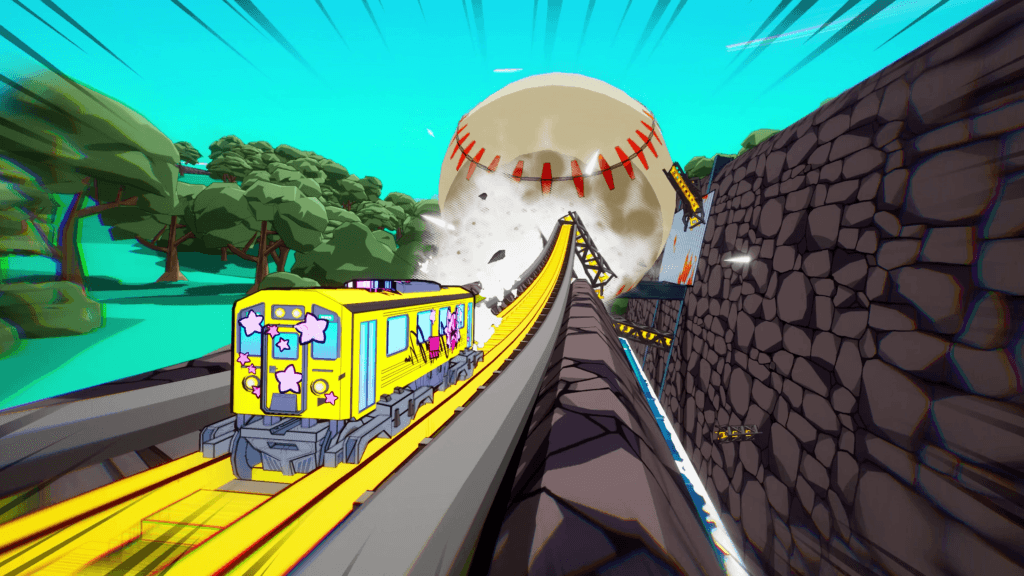
The story in Denshattack! is not subtle, but it does not need to be. The game knows exactly what sort of energy it wants: rebellion, community, defiance, and a little bit of absurdity to keep the whole thing from becoming too self-serious. You are pushing back against corporate power, making allies, meeting rival factions, and slowly becoming part of a larger resistance built on movement rather than speeches.
What I liked most is that the story never felt like it was trying to outgrow the game around it. It knows the real star is the act of playing, so it keeps the narrative bold and readable instead of drowning everything in lore. That restraint helps. I never felt like I was being asked to sit through pages of backstory just to get back to the fun. Instead, the story keeps reinforcing the same central idea: this is a world that has broken people down, and the only way through it is to keep moving anyway.
There is also a certain charm in how unapologetically heightened it all is. Denshattack! does not whisper its themes. It shouts them, then asks you to land a trick while it is shouting. That could have felt embarrassing in lesser hands. Here, it feels like conviction.
Where the Game Earns Its Name
This is where Denshattack! really locks in. The game’s biggest trick is that it makes a train feel agile, expressive, and weirdly personal. That alone would be enough to make it memorable. What makes it stick is the way the controls, level design, and scoring systems all push you to think in terms of flow.
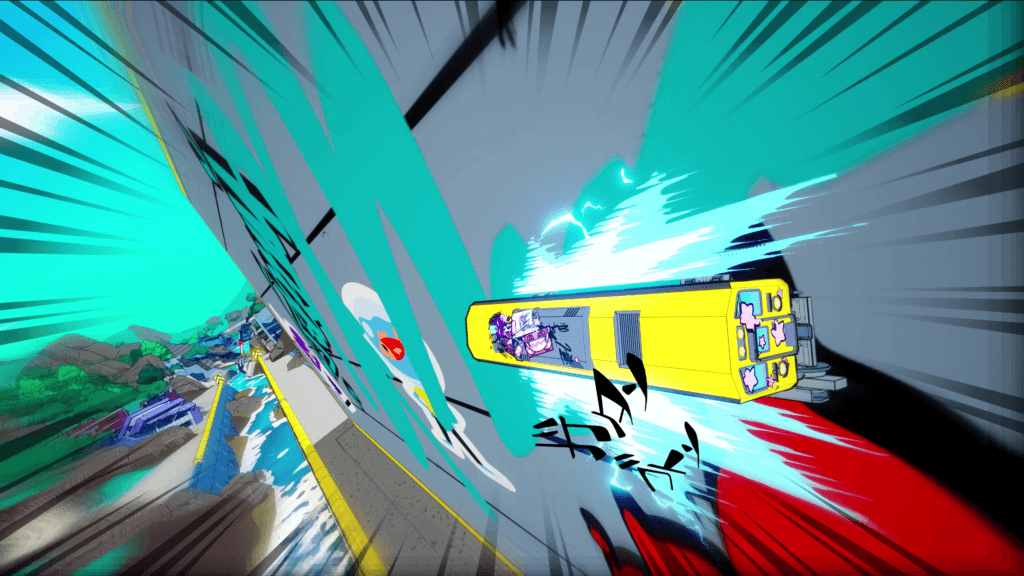
You are constantly learning how to string actions together. A clean route leads into a grind, a grind leads into a leap, a leap leads into a trick, and before long you are not merely surviving the level but performing through it. The game has that rare arcade quality where the rules are simple enough to understand quickly but deep enough to keep exposing new layers after you think you have figured it out.
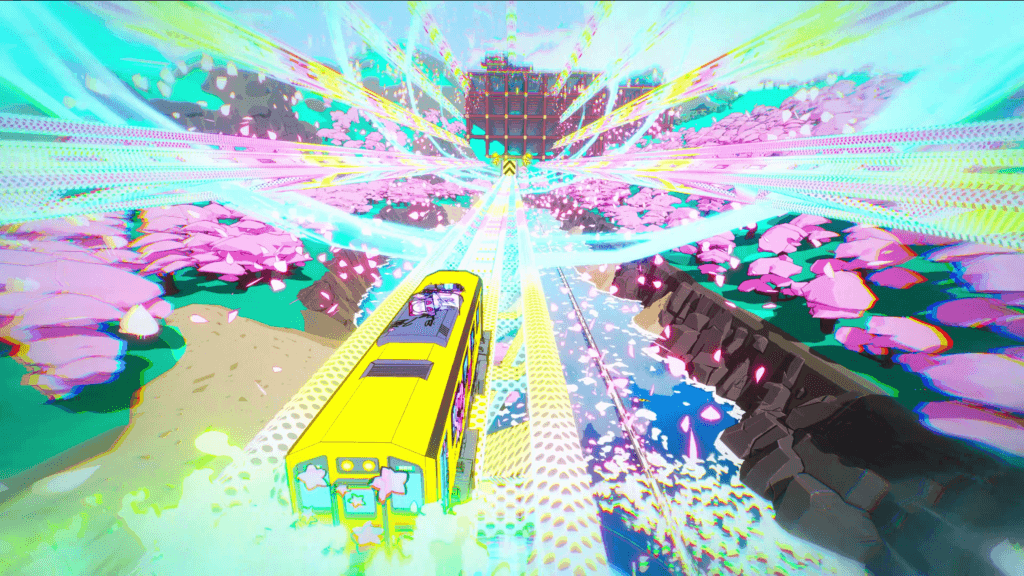
I appreciated how much Denshattack! respects momentum. It does not want you hesitating. It wants you to commit. That makes the game feel alive in a way a lot of more cautious action games never manage. Even when I messed up, I rarely felt like the game was punishing me unfairly. More often, it felt like I had let the rhythm slip for a second and the game had immediately noticed.
The best compliment I can give the gameplay is that it creates a very specific kind of mental state. After a while, you stop thinking in terms of individual inputs and start thinking in phrases. Move, boost, grind, turn, launch, repeat. It becomes almost musical. And once the game reaches that point, it is incredibly hard not to keep chasing one more run just to see if you can do it cleaner.
The level design supports that rhythm beautifully. Stages are built to reward confidence, and the game seems to enjoy putting pressure on you just as you are starting to get comfortable. That is exactly where Denshattack! is at its best. It wants you improvising. It wants you one step behind the chaos, then one step ahead of it, then fully in sync with it.
Why It Works and Where It Pushes Back
Pros
- The game has a strong identity and fully commits to its bizarre train-driven premise.
- Movement feels sharp, fast, and genuinely satisfying once the systems click.
- The rhythm of chaining tricks, grinds, and boosts creates a real flow state.
- Level design pushes you to stay aggressive and rewards clean execution.
- It is stylish, original, and never feels like it is playing things safe.
Cons
- It can be demanding, so it may not suit players looking for a relaxed experience.
- The unusual concept and tone will not land for everyone.
- It expects you to learn its rhythm, which can feel punishing at first.
Final Verdict – A Loud, Fast, Brilliantly Unhinged Ride
Score: 4.8/5

I finished Denshattack! impressed by how much more it was than its pitch. It would have been easy for this to be a one-note novelty, a game you admire for being unusual and then forget the moment something shinier came along. Instead, it turned into one of those rare experiences that proves an idea can be ridiculous and brilliant at the same time.
What stayed with me was not just the novelty of controlling a train that could flip and grind its way through a ruined future. It was the sense that every part of the game had been built to serve the same ecstatic purpose: keep moving, keep improvising, keep turning chaos into style.
That is a hell of a thing to pull off.
This review of Denshattack! is based on the PS5 Version, with the code provided by the Publisher/PR Agency.
About The Author