Avinash Rohra
 There was a stretch in the late ’90s and early 2000s when arcade games were obsessed with convincing us that the fastest route to a high score involved behaving like someone with absolutely no concern for personal safety. Tony Hawk had us launching ourselves down staircases. SSX turned mountains into elaborate playgrounds. OlliOlli eventually reduced skateboarding into something closer to a rhythm puzzle played at dangerous speed.
Freefall ’95 takes that philosophy and removes the ground.
You begin thousands of feet in the air while an aircraft disintegrates around you, which would normally be the end of somebody’s day. Here, it is the beginning of a combo. Luggage becomes something to kick. Debris becomes something to vault around. Objects hurtling past your head become opportunities to squeeze a few more points from a descent that is already going catastrophically wrong.
The premise got me through the door. What kept me there was how seriously S-Bend Games treats the mechanical side of such a ridiculous idea.
Falling With Purpose
Freefall ’95 wears its Tony Hawk and SSX influences openly, but the important comparison is not simply that all three games care about tricks. It is the way repeated attempts gradually turn a chaotic environment into a memorised route.
Each descent is handcrafted. That distinction matters because Freefall ’95 can look like the sort of score-driven game that would rely on procedural layouts, yet its stages are deliberately constructed spaces that reward familiarity. Containers and some smaller elements can introduce variation, but the underlying routes stay consistent enough that failure becomes useful information.
At first, I was mostly reacting.
Something appeared. I avoided it. Something else floated close enough to interact with. I pressed a button and hoped that whatever happened next counted toward the combo. It works for a while, but Freefall ’95 becomes far more interesting once that panic starts giving way to intention.
Repeated tricks lose value, so simply finding one reliable manoeuvre and hammering it is not enough. Better scores come from variety, extending combos through different interactions and understanding which pieces of the environment can be folded into the sequence. The more familiar I became with a stage, the less it looked like airborne clutter and the more it resembled a route waiting to be solved.
That is where the OlliOlli comparison started making more sense to me. Both games can initially look chaotic, yet their best moments come from recognising that apparent disorder has a rhythm.
Five Levels, Fifteen Ways to Panic
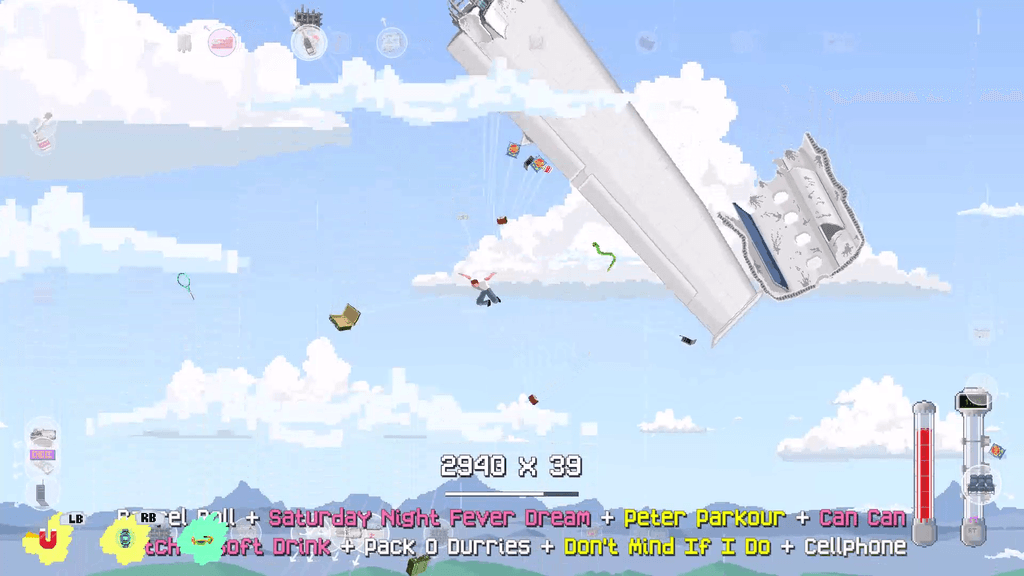
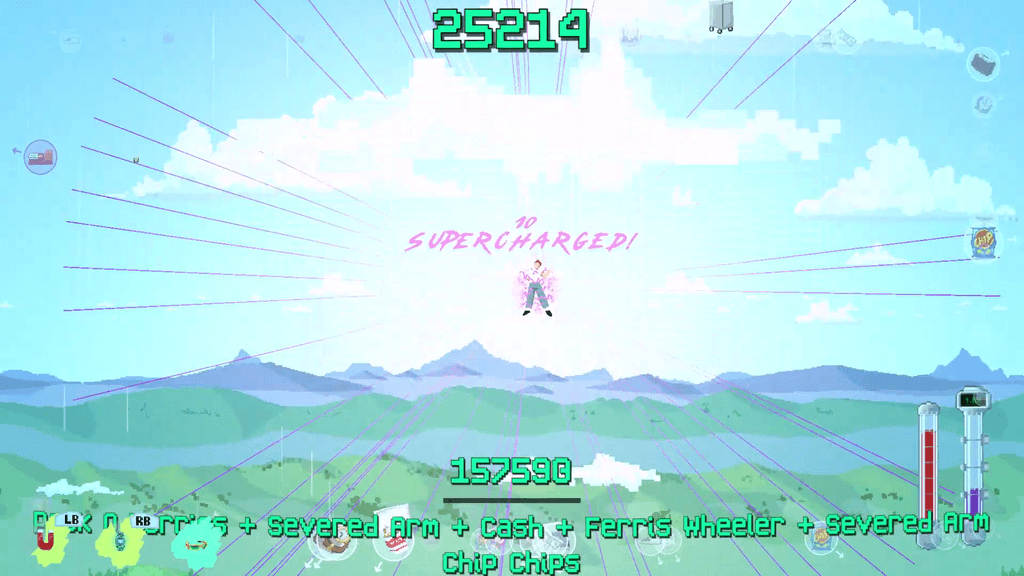
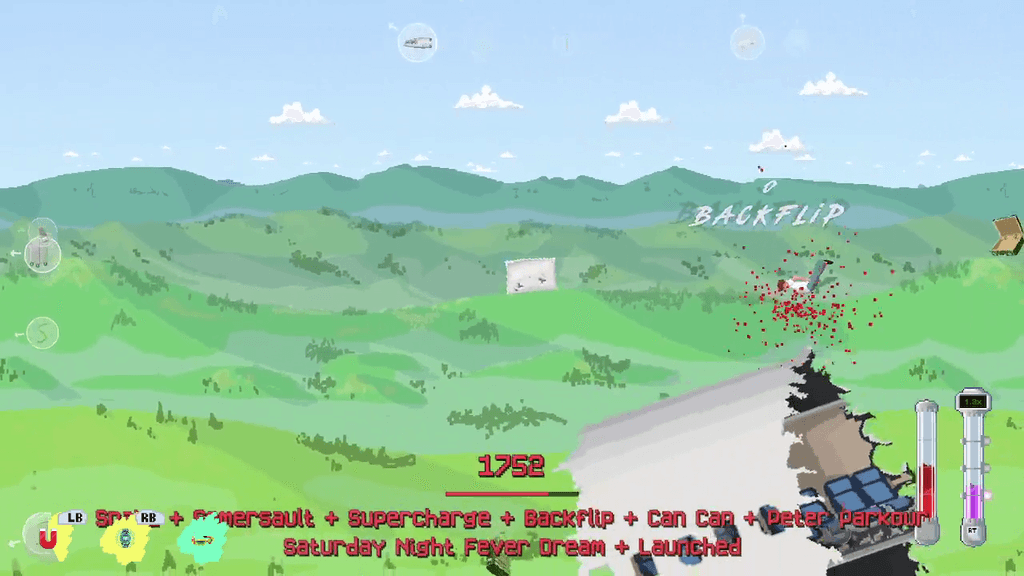
The core campaign is built around five environments spread across three difficulty tiers, creating 15 main stages. Later tiers are not simple repeats with inflated numbers. They become increasingly hostile versions of familiar spaces, with more hazards and tighter windows for keeping a run intact.
That escalation gets severe. Some of the later descents push close to bullet-hell territory, filling the screen with objects that are dangerous, useful, or sometimes both depending on what you are trying to accomplish.
Freefall ’95 occasionally struggles with readability here. The pixel-art presentation is full of personality, but when several pieces of debris cross the screen alongside collectibles, hazards and objects you can interact with, parsing the next safe move becomes difficult. Certain item effects can make that even messier.
It is worth separating that visual problem from how the game actually controls in its current state, because S-Bend Games has already addressed several launch complaints. Post-release updates enlarged interaction zones, reduced the speed of spinning debris, increased the threshold required for collision damage and made kicks and parkour interactions faster and more consistent. The game I am reviewing now is a more forgiving version of the same underlying idea.
It still wants concentration. It is simply better at ensuring that a missed interaction feels like my mistake rather than something I need to argue with.
The Worst Flight You’ll Happily Board Again
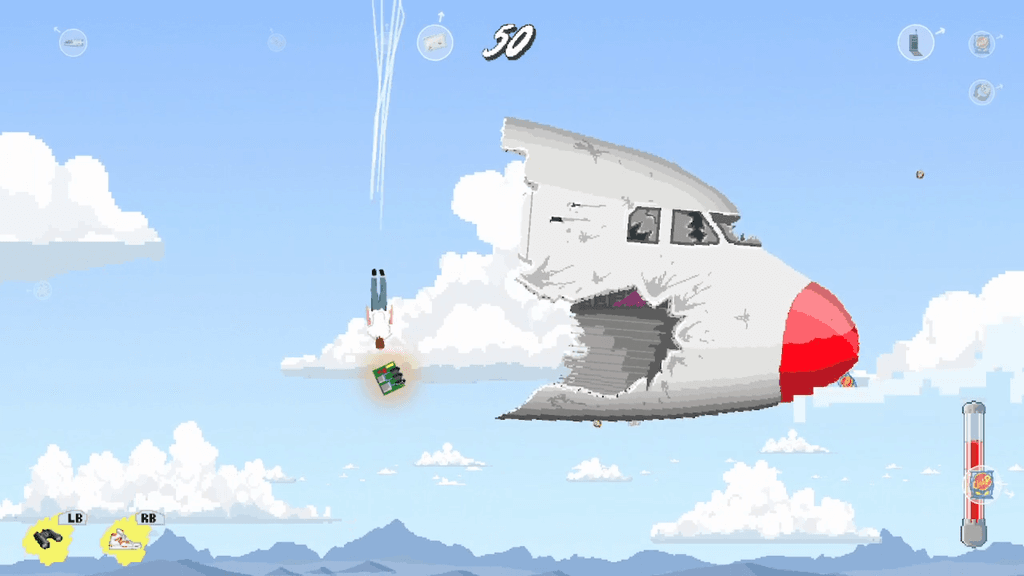
Between falls, you return to the aircraft before everything goes wrong.
This space gives Freefall ’95 more character than I expected. Passengers can be spoken to, quests appear, coins can be spent and the repeated disaster gradually becomes part of a broader time-loop mystery. You know what is going to happen. The people around you largely do not. Each return lets you prod a little further at why the flight keeps ending this way and whether there is anything you can do about it.
The story is light, and I would not recommend Freefall ’95 primarily for its narrative. What matters is how the plane stops repeated runs from becoming a row of disconnected score screens.
Progression also feeds into the next descent through Ability Items and Traits. Loadout decisions let you lean toward particular approaches without burying the arcade foundation beneath layers of statistics. The systems remain understandable enough that I spent more time thinking about how I wanted to fall than staring at upgrade menus.
That balance is important. Freefall ’95 knows what its main attraction is.
Challenges, Gauntlets and the Endless Drop
The current version also has more to do than the launch structure initially suggested.
Challenge Levels condense the scoring systems into shorter tests. Gauntlets push endurance instead, stringing together three, five or seven levels on a single health bar while offering reward choices after objectives.
The July update added Endless Fall, and it fits Freefall ’95 almost embarrassingly well.
Reach the wormhole near the bottom of a stage and the descent continues into another, increasingly difficult iteration. Multipliers climb while survival gets harder, turning the mode into the purest expression of the game’s score-chasing mentality. There is no need to invent a complicated justification for why somebody would keep falling forever. The number in the corner is going up. That is enough.
More importantly, Endless Fall gives players who have already internalised the main stages somewhere meaningful to take that knowledge.
Freefall ’95 is still repetitive by design. If improving routes, cleaning up mistakes and beating old scores does nothing for you, additional modes will not fundamentally change that relationship. The game asks you to enjoy repetition as practice.
I do.
A Distorted Tape From 1995
The visual identity makes the whole thing easier to love.
Freefall ’95 has the exaggerated confidence of something pretending that 1995 never ended. Chunky pixel art, loud menus and absurd airborne situations give it an energy that matches the premise without turning nostalgia into an endless sequence of references.
The soundtrack by Oscar Casley under the O.R.C name contains 12 pieces from the base game, and the electronic score suits the speed of play extremely well. A strong run starts to feel tied to its rhythm.
There is an obvious downside. Replaying handcrafted stages means hearing familiar music repeatedly, and the limited track count becomes noticeable across longer sessions. It never stopped me enjoying the audio, but this is a game I found more effective in concentrated bursts than marathon sessions.
That pacing also suits the humour. Freefall ’95 rarely pauses to underline its absurdity. Champagne, loose objects, ridiculous stunts and an aircraft falling apart around you are simply treated as normal working conditions.
Final Verdict – One More Fall
Score: 4.5/5
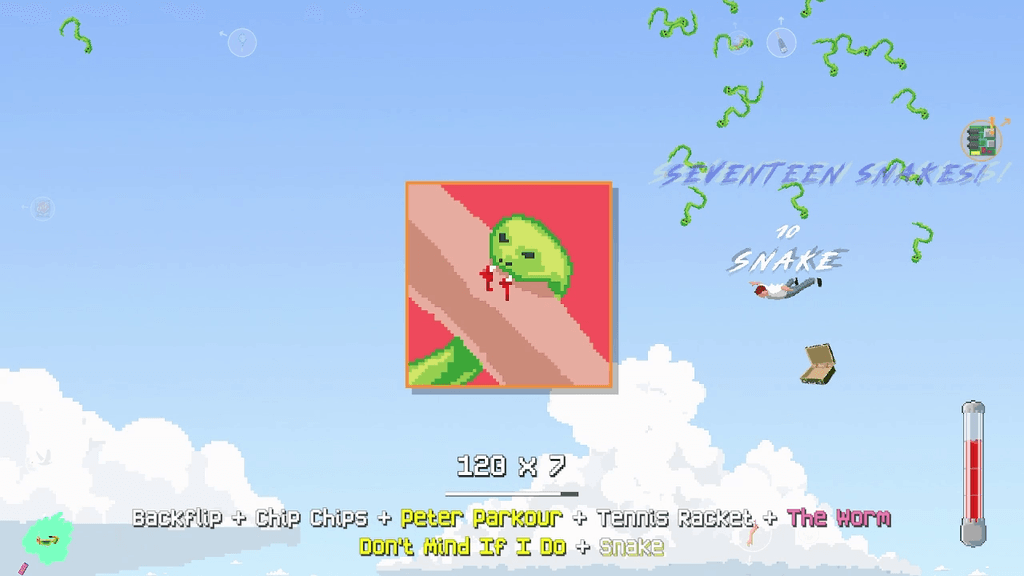
Freefall ’95 could have survived entirely on its premise. “Tony Hawk while falling out of a plane” is the kind of sentence that practically writes its own trailer.
Instead, S-Bend Games built something that rewards learning.
Its handcrafted layouts slowly become familiar. The scoring system forces variety instead of rewarding mindless repetition. Traits and Ability Items give progression some direction, while Challenges, Gauntlets and Endless Fall offer different ways to stress the same mechanical foundation. Later stages occasionally become visually crowded, the soundtrack can repeat too often, and anyone unmoved by score chasing will reach the edge of its appeal sooner.
I kept restarting anyway.
Eventually I stopped seeing an aircraft disaster and started seeing routes through it.
This review of Freefall ‘95 is based on the PC Version, with the code provided by the Publisher/PR Agency.
About The Author