Avinash Rohra
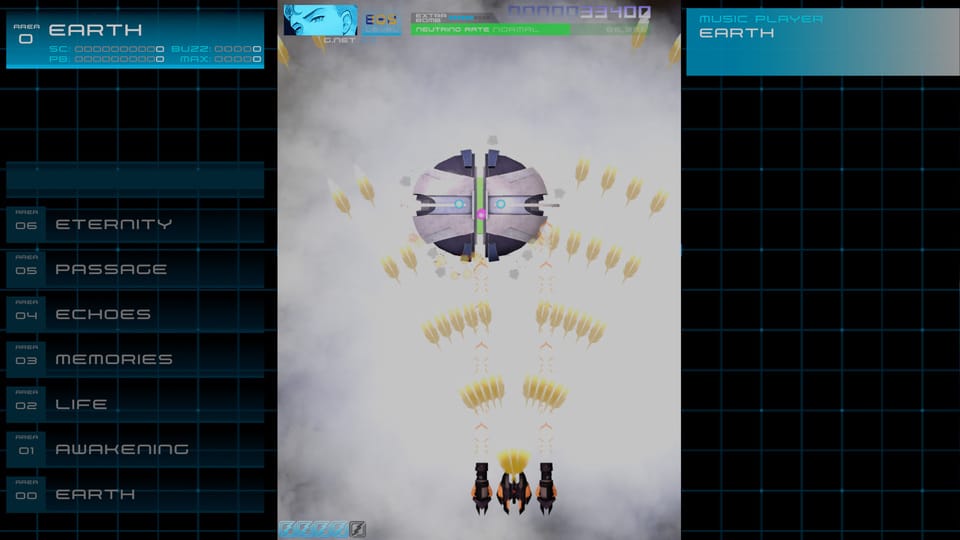
Most shoot ’em ups spend years teaching you to fear crowded screens. Psyvariar 3 spends its first few stages undoing that instinct. When dozens of bullets begin closing around the ship, the obvious reaction is to retreat toward whatever patch of empty space remains. Psyvariar wants something entirely different. It wants you close enough to danger that the edge of a projectile almost touches you, turning what would normally be a desperate escape into an opportunity to Buzz, build score and strengthen your position.
That idea has always separated Psyvariar from many of its contemporaries, and more than twenty years after Psyvariar 2, it remains the reason this sequel works. The presentation occasionally makes a poor first impression and the game could explain its systems considerably better, but the longer I played the Nintendo Switch 2 version, the easier it became to look past those weaknesses. Once I stopped playing purely for survival and started treating enemy fire as something I could exploit, Psyvariar 3 became a much more interesting shooter.
Living on the Edge
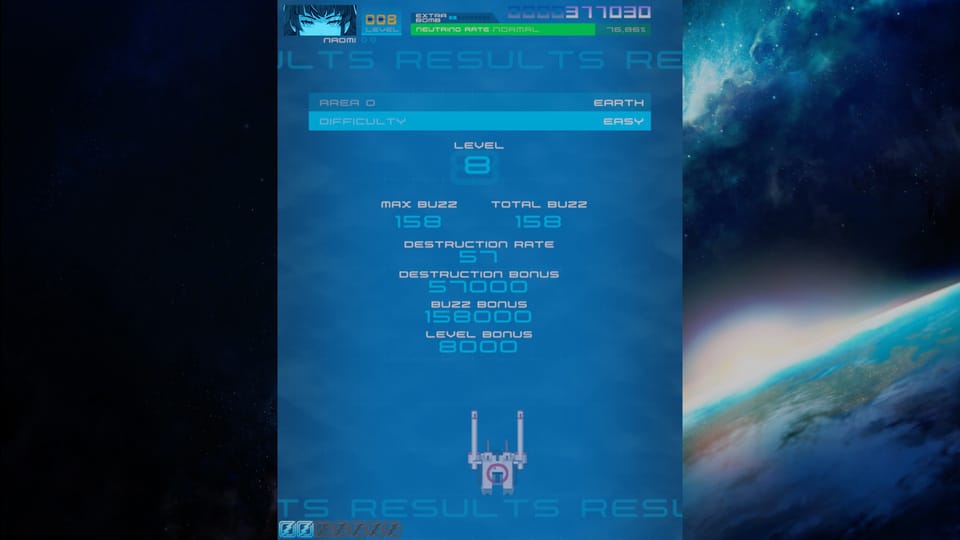
Buzzing is the centre of almost everything Psyvariar 3 asks from you. Flying close to enemy bullets contributes towards levelling, scoring and shield chains, so the relationship between risk and reward feels different from a shooter built entirely around finding safe lanes. You still need to dodge, naturally, but the game continually tempts you to stay near a pattern for another fraction of a second because that dangerous position may be more valuable than immediately escaping it.
There is more happening underneath that central mechanic than the opening stages initially suggest. The returning Roll system can be activated through modern controls while retaining the older directional wiggle input, while the Neutrino and Shield mechanics tie Buzzing and attacking into shields, speed improvements and weapon upgrades. Bomb behaviour also changes between pilots, including short and long variations, which prevents the roster from feeling like seven cosmetic versions of the same ship.
Learning those relationships became the part I enjoyed most. Psyvariar 3 rewards the moment when a pattern that previously looked impossible starts looking readable, and then goes one step further by asking whether you can deliberately move closer to it. There is a satisfying arrogance to a good run. You are no longer merely surviving what the game throws at you. You are actively looking for more bullets.
Seven Pilots, Seven Ways to Chase a Score
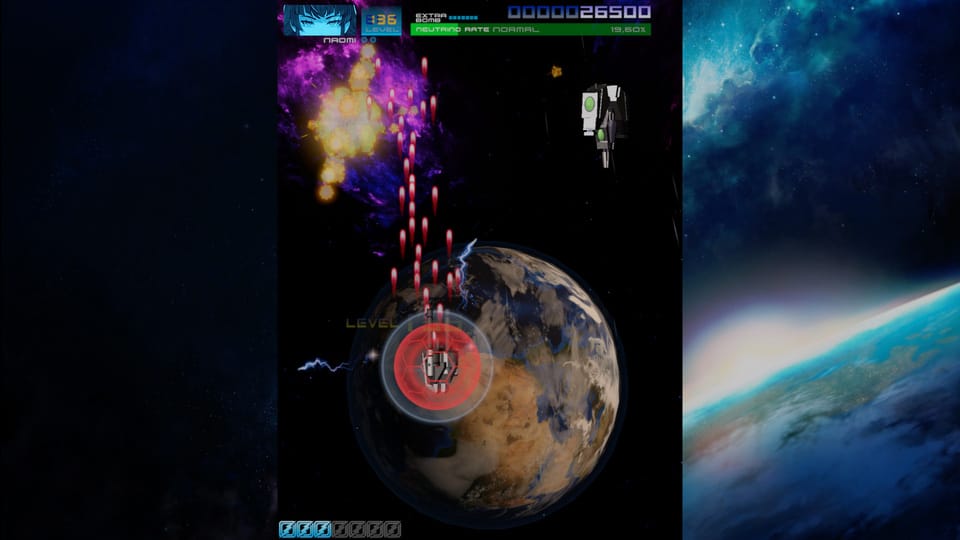
All seven playable characters are available as part of the core roster, including Cotton as the guest character from Success’ Cotton series. Their differences extend beyond weapon shape, with unique Buzz properties, bomb behaviour and scoring systems changing what constitutes an effective run.
That variety gives Psyvariar 3 considerable replay value because learning one pilot does not automatically mean understanding another. A comfortable route through a stage can become less useful after changing characters, particularly when a pilot encourages a different relationship with Buzz or offers different offensive tools.
Arcade Mode remains the obvious centrepiece and takes place across seven areas. Difficulty is adjusted according to performance, opening harder routes and different boss encounters when you play well. It gives repeated runs a purpose beyond chasing a larger number on the leaderboard because improving at the game gradually exposes nastier versions of material you already thought you understood.
The broader mode selection supports that arcade structure rather well. Arrange modifies the core rules, Caravan reduces the scoring chase to two minutes, Endless pushes survival, Practice allows individual sections to be studied and Mission Mode contains 49 short challenges. Those missions became especially useful because Psyvariar 3 does not always communicate its mechanical subtleties gracefully. Having smaller objectives gives you somewhere to experiment without committing to another complete Arcade run.
Switch 2 Is a Natural Home for It
The Nintendo Switch 2 version gives players a genuine choice between image quality and frame rate. Quality Mode reaches 4K at 60fps when docked and 1080p at 60fps handheld, while Performance Mode offers 1080p at 120fps on a compatible TV and 720p at 120fps in handheld play.
I kept returning to Performance Mode. Psyvariar 3 is a game of minute corrections and deliberate proximity to bullets, so the attraction of 120fps is easy to understand when patterns become dense. The extra resolution of Quality Mode is welcome, particularly on a large screen, but this is exactly the sort of game where responsiveness carries more value for me than visual sharpness.
The Switch 2 upgrade is also free if you already own the Nintendo Switch release, which makes the improved display options a welcome addition rather than another purchase.
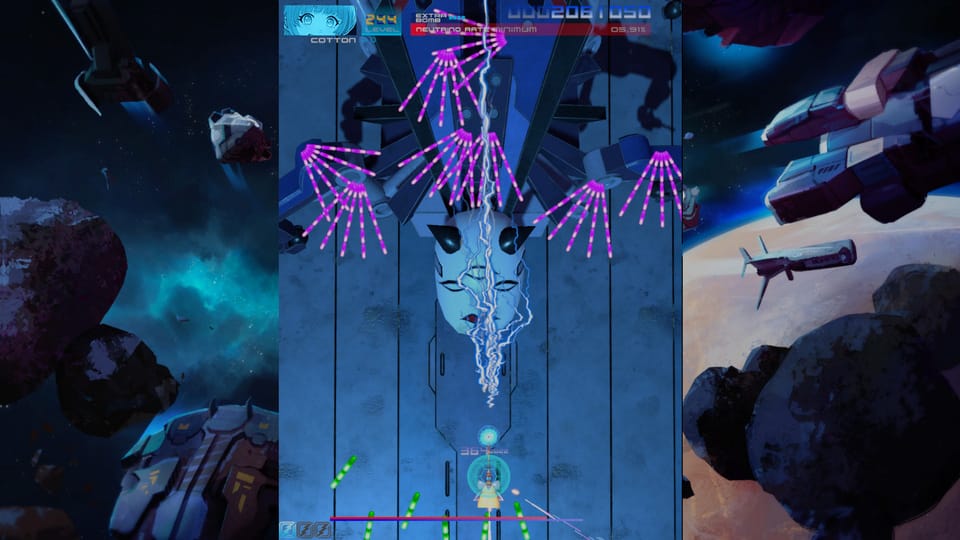
Where the hardware cannot help is the underlying visual direction. Psyvariar 3 intentionally adopts what its developers describe as a neo-retro 3D style inspired by the earlier games, and sometimes that chunky appearance has genuine arcade charm. At other points, ships, enemies and environments simply look plain. Several backgrounds are visually busy enough to compete with the objects that actually matter, an issue made more noticeable in a game where reading individual projectiles is fundamental to scoring well.
Thankfully, the options are unusually useful. You can adjust presentation elements, display the hitbox, alter bullet visibility and rotate the screen for vertical play. These settings help considerably, although I would have preferred stronger readability from the default presentation rather than needing to tune it myself.
More Substance Than Its Looks Suggest
Psyvariar 3 is one of those games that sells itself badly in screenshots. Its modelling can look dated, its menus are functional rather than attractive and its audiovisual identity does not immediately announce the return of a series that has been waiting more than two decades for another numbered entry. The first hour therefore creates an odd disconnect between something that looks modest and something mechanically much richer underneath.
That richness kept pulling me back.
A good Arcade run becomes a constant negotiation with your own instincts. Staying safe can mean wasting a profitable pattern. Destroying something immediately may deny you the bullets you could have Buzzed. A section that once looked overwhelming eventually becomes a scoring opportunity, and suddenly you are annoyed when an enemy dies too quickly because you wanted it to fill the screen with more ammunition.
That is the moment Psyvariar 3 makes sense. It is less interested in teaching you how to survive a bullet hell than teaching you why surviving cautiously can be the wrong way to play one.
Pros and Cons
Pros
- Buzz remains an excellent risk-and-reward scoring mechanic
- Seven pilots offer meaningful mechanical differences
- Strong selection of modes around the arcade campaign
- Dynamic difficulty makes repeated runs increasingly interesting
- Mission Mode provides useful opportunities to learn individual systems
- 120fps Performance Mode is particularly well suited to Switch 2
Cons
- Important mechanics are not explained as clearly as they should be
- Neo-retro visuals occasionally look more dated than intentional
- Some backgrounds interfere with immediate visual readability
- Presentation lacks the polish of the strongest modern shoot ’em ups
Final Verdict
Score – 3/5
Psyvariar 3 does not make the strongest first impression. Its visuals are inconsistent, the tutorials leave too much knowledge buried inside experimentation and a sequel arriving after such a long absence deserved a little more polish around its mechanical core.
Spend enough time actually Buzzing through its bullet patterns, though, and those complaints become easier to put aside. The seven pilots give scoring runs different personalities, the difficulty system rewards genuine improvement and the range of modes supports the sort of repetition an arcade shooter needs. The Nintendo Switch 2 edition complements all of this especially well, with 120fps play fitting a game built around placing your ship frighteningly close to things designed to kill it.
Psyvariar 3 understands the strange pleasure that made the series memorable in the first place. Every other shooter tells me to get away from the bullets. This one keeps convincing me to fly closer.
This review of Psyvariar is based on the Nintendo Switch 2 Version, with the code provided by the Publisher/PR Agency.
About The Author