Isle of Reveries Review – Getting Lost Has Rarely Felt This Rewarding
 Avinash Rohra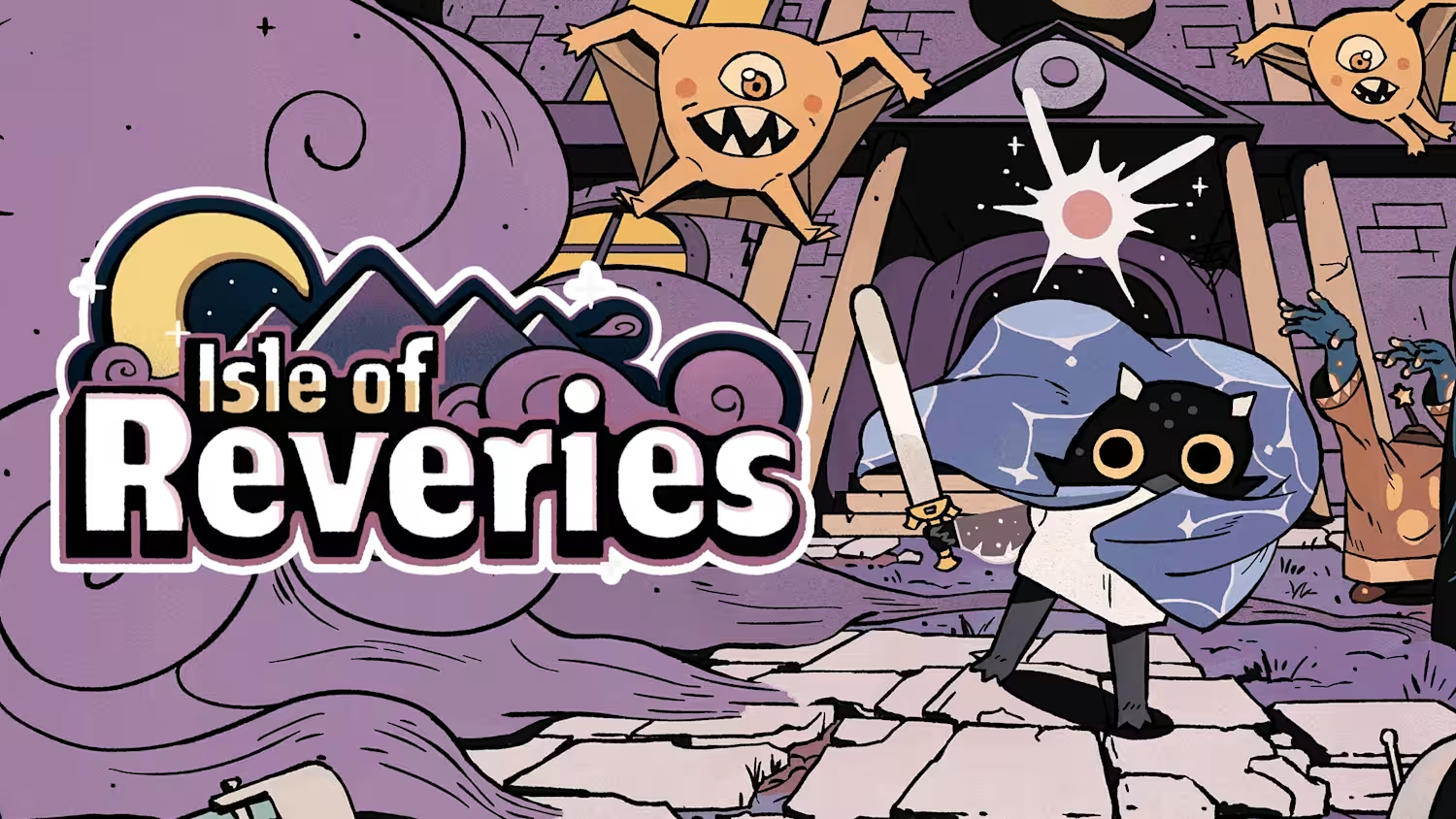
There was a point, several hours into Isle of Reveries, when I realised I had completely forgotten what I was supposed to be doing. I had gone looking for the route to my next objective, spotted something suspicious at the edge of a screen, wandered off to investigate it and somehow ended up revisiting an area I had passed through much earlier. By the time I remembered why I had started walking in the first place, I had found a collectible, rescued another character and mentally marked two places I wanted to return to later.
For once, getting distracted felt like the correct way to play.
I went into Isle of Reveries with some reservations because its influences are hardly subtle. Desertcucco clearly loves the Game Boy Color era of The Legend of Zelda, particularly Link’s Awakening and the Oracle games, and you do not need to spend long on the island before those comparisons begin forming. Lief, an owl travelling to the mysterious Isle of Reveries in pursuit of a wish, explores a compact overworld filled with dungeons, blocked paths, strange inhabitants, secrets and new tools that gradually change how familiar places can be approached.
I have played enough games built from that template to be wary when nostalgia is doing most of the selling. Isle of Reveries did not win me over because it reminded me of Zelda. It won me over when I started getting stuck.
The Dungeons Are Where It Clicked
Lief travels with a fairy capable of copying certain objects and recreating them elsewhere. It initially seems like a neat puzzle gimmick, but the game keeps finding uses for it long after the novelty should have worn off.
A copied object can become a platform, a component of a larger environmental puzzle or something that interacts with one of Lief’s other abilities. More importantly, the game does not abandon its older mechanics whenever a new item arrives. The seven dungeons gradually ask you to think about several parts of your inventory at once, which made progression feel less like collecting an increasingly large key ring and more like expanding a small toolbox.
Some of my favourite rooms were also the ones I disliked most for about five minutes.
I would push things around, try the obvious item, convince myself I must have arrived too early and leave. Then something would click while I was halfway through another room. Going back and discovering that the answer had been sitting in front of me the entire time was consistently satisfying because the game rarely needed an elaborate explanation afterward. Once understood, most solutions make immediate sense.
That quality becomes more noticeable as the dungeons grow larger. Their themes are not simply cosmetic; each introduces ideas that develop across successive rooms before eventually overlapping with mechanics learnt elsewhere. By the later sections I was entering rooms already thinking about what could be copied, what could be moved and which older ability I had probably forgotten about.
The bosses are enjoyable extensions of that philosophy rather than enormous departures from it. They are not the main reason I looked forward to another dungeon, but they give Lief’s growing selection of tools something more energetic to do after long stretches of puzzle solving.
Getting Around Is Not Always As Enjoyable
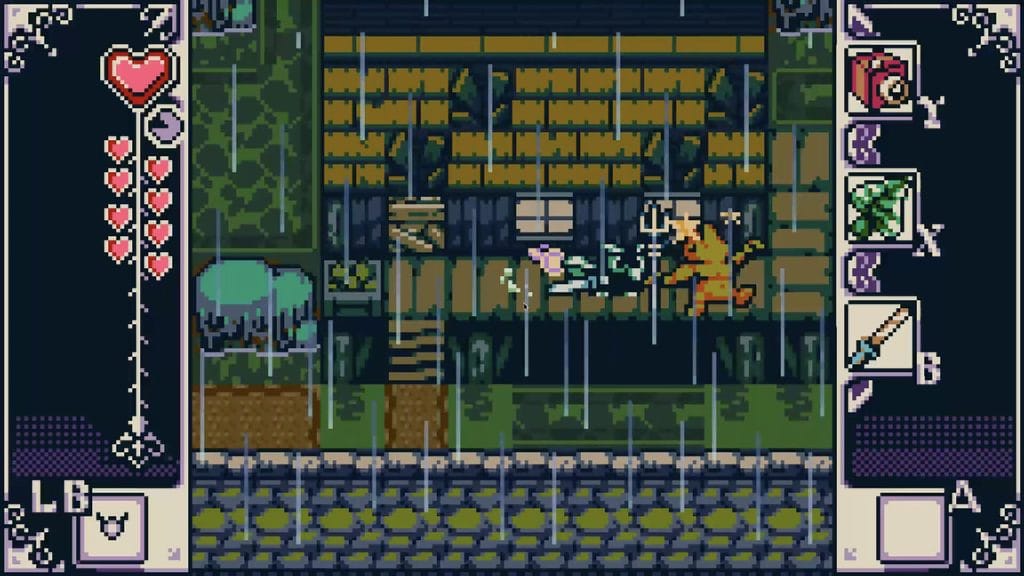
The overworld gave me a much more complicated relationship with the game.
There are eight biomes, and the island is packed unusually tightly with characters, optional routes, collectibles, quests and areas that cannot be fully explored when you first encounter them. Returning with a new ability often reveals something useful, so I became increasingly obsessive about remembering odd-looking ledges or objects that seemed deliberately inaccessible.
The downside is that Isle of Reveries occasionally mistakes inconvenience for exploration.
Paths wind around one another, apparently nearby locations can require lengthy detours and the route between two familiar places is not always as intuitive as it should be. Early on, I enjoyed having to learn the island instead of simply following markers. Later, there were journeys where I knew precisely where I wanted to go and still had to take the scenic route for no particularly interesting reason.
Some players have raised similar complaints about how densely the overworld is arranged, and I understand why. There is a difference between becoming familiar with a place and repeatedly negotiating the same awkward route.
The saving grace is that I rarely travelled for very long without finding something else worth investigating. The island is good at putting a distraction just far enough away from the obvious route that curiosity takes over. Rescued characters also contribute to the township, gradually populating it and giving exploration a consequence beyond filling out a checklist.
I became rather attached to seeing that little settlement grow. It is not an elaborate city-building system, nor does it need to be. Having people appear because of things I had actually done made the island feel more connected than it otherwise might have.
Fighting Is Fine, Jumping Less So
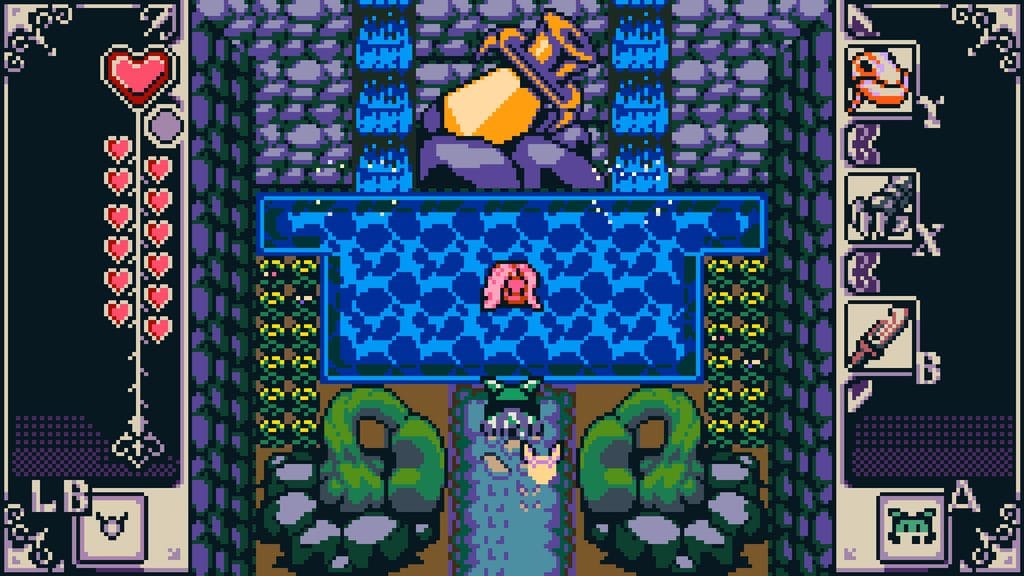
Combat is probably the part of Isle of Reveries I thought about least whenever I stopped playing.
Lief has a sword and several additional tools, and enemies increasingly require you to do more than simply walk towards them swinging. Certain encounters make intelligent use of abilities acquired through the dungeons, but combat never develops with quite the same imagination as the puzzles.
Magic regeneration can slow things down further. When an encounter requires a particular ability, exhausting the meter can sometimes leave you avoiding an enemy while waiting for the resource to return. It never became a serious problem for me, although after solving a clever dungeon room it could make the next ordinary fight feel distinctly pedestrian.
Jumping bothered me more.
Giving Lief a dedicated jump makes sense because vertical movement is worked directly into exploration and puzzle design, but judging distance from the overhead perspective can be awkward. Most jumps are straightforward, yet there were enough narrowly missed landings for me to become wary whenever precision mattered. The developer has already adjusted jump distance and addressed several other progression and quality-of-life issues through post-launch updates on PC, alongside fixes for bugs and possible softlocks.
I played the standard Nintendo Switch version on Switch 2 through backward compatibility rather than a dedicated Switch 2 edition. It suits handheld play extremely well. The structure constantly produces natural stopping points, although I rarely respected them. I would finish a dungeon room, decide that was enough for the night and then notice another unexplored exit.
Forty minutes later, I would still be playing.
The Island Is Stranger Than It First Appears
The presentation could easily have relied entirely on nostalgia, but I found considerably more personality here than the initial screenshots suggested.
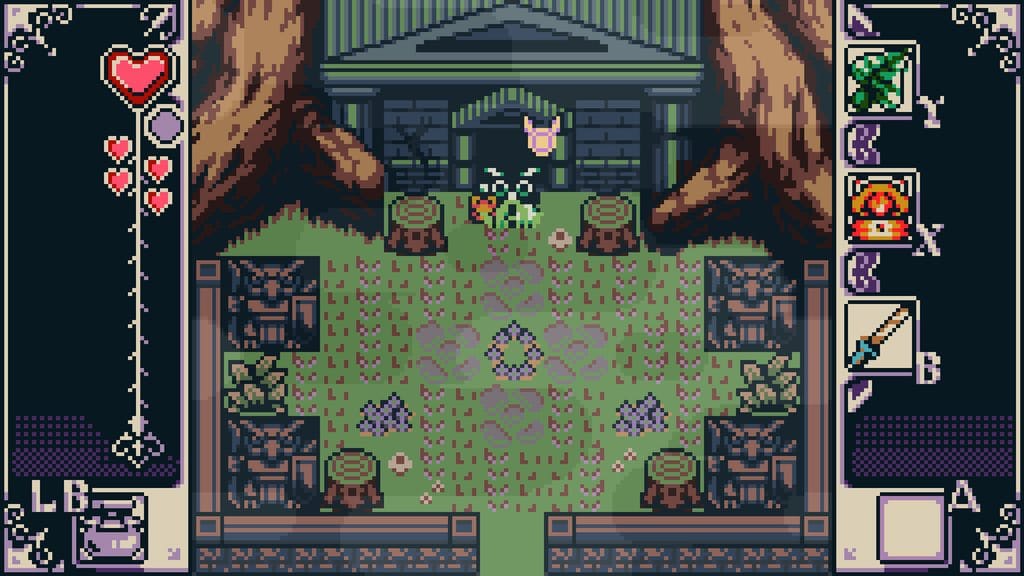
The pixel art has enough detail to make each biome immediately identifiable without losing the chunky character of the games it references. Lief and the island’s inhabitants are expressive despite their size, and small environmental details help individual areas avoid becoming collections of interchangeable square screens.
The soundtrack deserves similar praise. It captures the buoyancy I associate with portable adventures from that period without constantly sounding as though it is attempting to impersonate one particular soundtrack. Some pieces are energetic and playful, while others quietly reinforce the stranger and more melancholic parts of the island.
That melancholy became more important to me as the story progressed.
Lief is travelling somewhere people visit because they want their wishes granted, and there is an inherent sadness in that idea which Isle of Reveries gradually explores. The animal characters and colourful environments initially disguise how lonely the premise can be. These are people defined, to some degree, by wanting something badly enough to come here.
The story remains relatively light and never overwhelms the adventure with exposition, which I appreciated. I would not claim that every character became unforgettable, but I cared about the island considerably more at the end than I expected to when I first arrived.
Familiar, Until It Isn’t
The obvious comparison throughout Isle of Reveries is Zelda, but by the end I found that comparison increasingly unhelpful.
Yes, the lineage is unmistakable. There are pieces of Link’s Awakening and the Oracle games everywhere, from the structure of exploration to the rhythm of discovering items and returning to old locations with new possibilities. Desertcucco has been open about those inspirations, so pretending otherwise would be pointless.
What mattered to me was that after the opening hours, I was no longer playing purely to see how those influences had been rearranged.
I wanted to know what the next dungeon would ask of me. I wanted to revisit places where I had left something unresolved. I wanted to keep adding people to the township. More than once I reopened the game intending to check one location and ended up completing an entire sequence because every discovery suggested another.
That is also why its weaker moments irritated me. I would happily spend twenty minutes thinking through a stubborn puzzle, yet resent five minutes spent retracing an unnecessarily convoluted route. I enjoyed experimenting with the fairy mechanic but regularly ran past ordinary enemies because fighting them was less interesting than whatever waited in the next room.
Those imperfections stop this from being the effortless adventure its inspirations sometimes were, but they never came close to cancelling out what Isle of Reveries does particularly well.
Pros and Cons
Pros
- Consistently inventive dungeon and puzzle design
- The fairy’s copy mechanic remains useful throughout the adventure
- New abilities meaningfully interact with older ones
- Dense overworld full of worthwhile secrets and reasons to return
- Township progression makes rescuing characters feel consequential
- Excellent pixel art and a strong chiptune soundtrack
- Exploration regularly leads to genuinely rewarding distractions
Cons
- Overworld routes can become unnecessarily convoluted
- Combat never reaches the quality of the puzzle design
- Magic regeneration occasionally slows encounters down
- Top-down jumping can feel imprecise
Final Verdict
Score: 4.5/5
I expected Isle of Reveries to be another pleasant indie game borrowing the language of an older Zelda. For the first hour or two, I was still looking at it that way.
Then I started remembering rooms while I was away from the game.
I would suddenly realise how a puzzle might work, or remember a blocked route that a newly acquired ability could probably open. At one point I loaded my save specifically to test one of those ideas, found that I was right, noticed something else nearby and lost another hour.
That is the part of Isle of Reveries I will remember. Not the obvious references, not the occasional irritating detour and certainly not every enemy I fought along the way. I will remember staring at a room until its logic finally made sense, wandering somewhere I had no reason to visit yet and being rewarded for doing it, and watching an island that initially seemed like a nostalgic playground gradually reveal something much more thoughtful underneath.
For a game so openly fascinated with adventures from the past, Isle of Reveries is at its best when it stops reminding me of them.
This review of Isle of Reveries is based on the Nintendo Switch 2 Version, with the code provided by the Publisher/PR Agency.
About The Author