Moonlighter 2 Review – A Bigger Shop With Less Soul Behind the Counter
 Avinash Rohra
There was a point during Moonlighter 2: The Endless Vault when I realised I was thinking far more about getting back into a dungeon than opening my shop.
For another action roguelite, that would hardly qualify as a problem. For Moonlighter, it gets to the heart of why this sequel has left me so conflicted. Digital Sun has spent months expanding and reshaping the game through Early Access, and the version that reached 1.0 is considerably richer than the one players first encountered. Combat has more build variety, the shop has been reworked in response to feedback, Bloblets add another layer to business management, and there is substantially more to pursue after the story ends.
I respect a lot of those changes. I just don’t think they have resulted in a stronger balance between being an adventurer and being a merchant.
Starting Again in Tresna
Will and the people of Rynoka find themselves displaced in Tresna after their home falls under the control of Moloch, an interdimensional collector with a habit of treating entire worlds like possessions. Starting again means rebuilding a business while Will heads into dangerous dimensions looking for relics worth selling.
That basic loop still works beautifully.
Enter a dungeon, fight through rooms, fill the backpack, return to town and convert those discoveries into money. The money then feeds back into equipment, the shop and progression around Tresna before another run begins.
Moonlighter 2 simply puts considerably more machinery around it.
Digital Sun expanded the game throughout Early Access with additional weapons and gadgets, new perk paths such as Hex and Poison, Boss Rush, Greed Colosseum, Bloblets, extra combat rooms and broader shop customisation. The eventual 1.0 release pushed things further with the Bomb perk path, additional equipment, Hardcore Mode, more vendors and the completed story.
This isn’t a case where the sequel lacks things to do.
Fighting Has Clearly Won the Argument
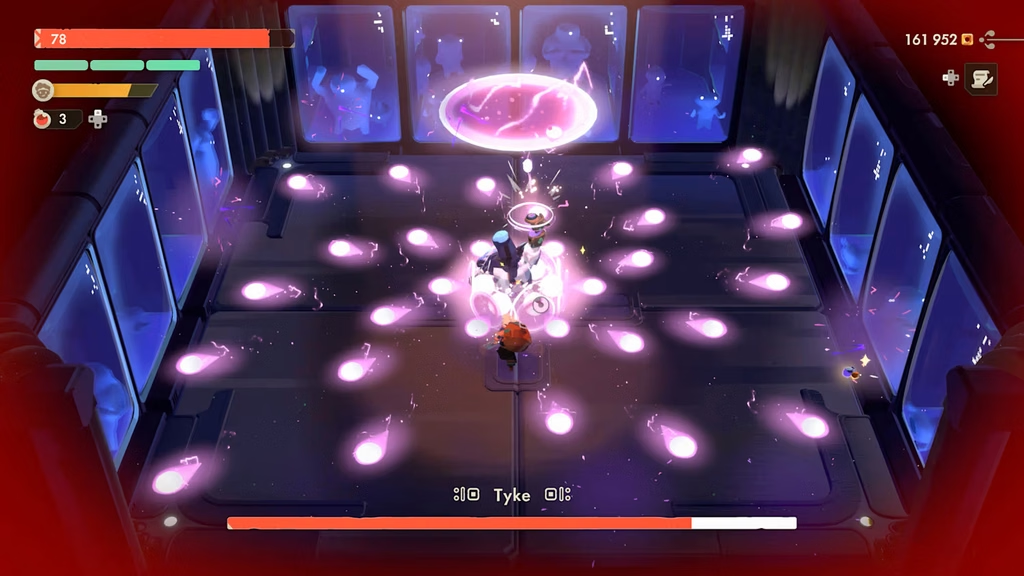
Combat is where the improvements are easiest to appreciate.
Four weapon families create meaningfully different rhythms, while gadgets and perk paths allow runs to move away from their starting template. The Bomb path, for example, lets repeated attacks mark enemies before triggering explosions, while other perk combinations encourage different status effects and approaches.
Positioning also matters more than I expected. Knocking enemies around isn’t merely decorative when hazards, groups and room layouts can turn displacement into another form of damage.
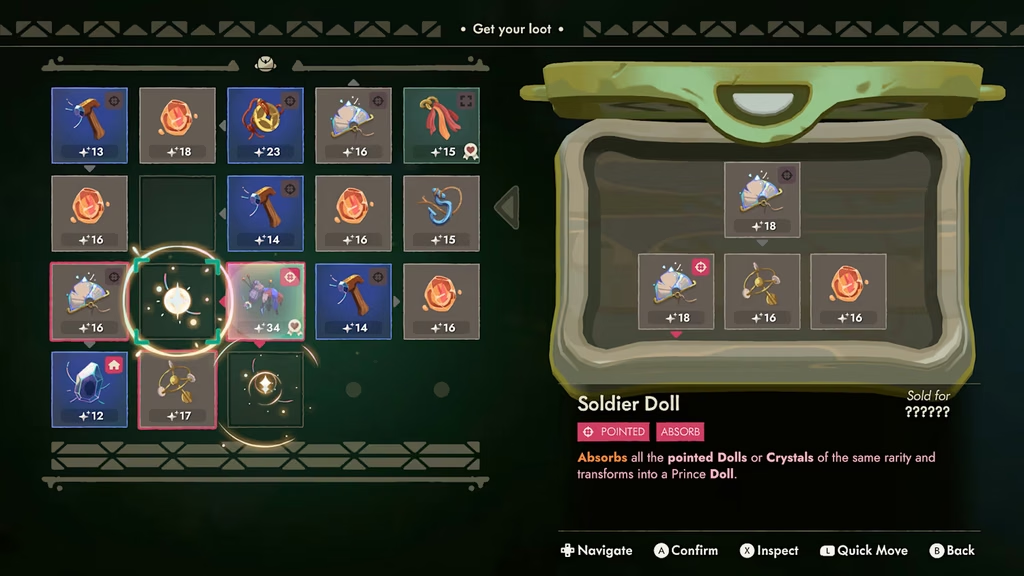
Then there is the backpack, which remains one of Moonlighter’s smartest ideas.
Relics can interact with nearby objects depending on their placement and properties. A valuable pickup therefore doesn’t automatically mean another free inventory slot disappearing. Sometimes I was rebuilding half the backpack around it, trying to preserve one useful interaction without destroying another.
It makes greed wonderfully inconvenient.
The Greed Colosseum builds further on that appetite for pushing a run beyond the sensible stopping point, while Boss Rush gives players who enjoy Moonlighter primarily for its action another dedicated challenge. The combat half of the game has plainly grown since Early Access, and by 1.0 there is enough build experimentation here to make returning to familiar areas more interesting than simply repeating the same rooms with larger numbers.
The Shop Was Fixed, But Something Still Feels Missing
This part requires an important distinction from Moonlighter 2’s early demo.
Digital Sun initially redesigned selling because the team felt the first game’s price-discovery loop eventually became repetitive. Players pushed back, arguing that manually experimenting with prices was central to being a merchant. Digital Sun listened. Manual pricing returned before Early Access, bringing customer reactions and price experimentation back with it.
The current game therefore isn’t the simplified shop system that some early impressions described.
There are more variables now too. Relic quality and popularity affect selling, while furniture, perks, Bloblets and other bonuses provide ways to squeeze more from a day’s business. Price information also becomes easier to retain and interpret as you learn the market.
Yet I still found the shop less absorbing than the dungeon.
The original Moonlighter often made selling feel like its own game. I watched faces, changed prices, remembered mistakes and gradually learned how far I could push a customer before enthusiasm became outrage.
Moonlighter 2 still contains that behaviour, but its surrounding progression makes the shop feel more transactional. Gold feeds so many systems that I increasingly viewed relics according to what upgrade their sale would finance rather than what kind of merchant decision they represented.
That distinction sounds small until you’ve spent hours repeating the loop.
1.0 Has Much More Waiting After the Story

The full release also deserves credit for addressing longevity.
Completing Will’s main storyline isn’t the end. The Infinite Endless Vault extends progression through increasingly demanding thresholds built around earning the required amount of gold within a run. Equipment, shop improvements, cosmetics and other rewards give players reasons to keep going after the conventional ending.
Hardcore Mode attacks longevity from another direction by making death dramatically more consequential and forcing players who want that punishment to rethink their normal risk-taking habits.
Both additions fit Moonlighter 2 well. They also reinforce where the sequel’s priorities have moved. I can imagine players who enjoy optimising builds and repeating runs spending far longer here than I did.
My problem was that repeating those runs eventually exposed how much less interested I had become in coming home.
Switch 2 Is Better, But Still Needs Work
The Nintendo Switch 2 version has changed noticeably since its rougher pre-release state.
Digital Sun released an early stability update and has since moved the game to version 1.0.43.3. The latest patch specifically targets loading between rooms, chest-opening delays, softlocks, progression issues and several situations that previously produced infinite loading screens.
My time with the current version was considerably better than those early days.
That doesn’t mean the port is spotless. Loading remains more noticeable than it should be in a game that constantly moves between rooms and activities, and performance can still lose some smoothness during busier moments, so I wouldn’t describe the technical situation as settled yet.
The underlying format is nevertheless a terrific fit for handheld play. Short dungeon excursions followed by a shop session make it easy to play in smaller bursts.
Final Verdict
Score: 3/5
Moonlighter 2 is difficult for me to dislike. Its combat is stronger. Its buildcraft is broader. The backpack remains clever. Digital Sun has clearly reacted to criticism rather than stubbornly sticking to systems players rejected, and the amount of work between the early demo, Early Access and 1.0 is obvious.
But sequels don’t exist only to accumulate improvements.
The first Moonlighter made me equally interested in what happened beyond the dungeon door and behind the counter. Its strange identity came from those two halves constantly depending on each other.
Here, I increasingly treated selling as the interval between the parts I actually wanted to play.
For someone who wanted Moonlighter to become a fuller action roguelite, The Endless Vault may be closer to that ideal than the original ever was. I wanted the merchant fantasy to grow alongside it.
Instead, I got a bigger game and found myself missing the smaller one’s priorities.
This review of Moonlighter 2 is based on the Nintendo Switch Version, with the code provided by the Publisher/PR Agency.
About The Author