Avinash Rohra
There’s a moment, somewhere around your fifth or sixth in-game day in Tiny Bookshop, when you realize you’re no longer playing for progression, you’re playing for people. I hit that point about 4 hours in on PS5, long after I’d figured out the mechanics, but just as the game started revealing its real strength: emotional investment through routine.
On paper, Tiny Bookshop sounds dangerously slight. A mobile bookstore. A seaside town. No fail state, no combat, no urgency. In an era where even “cozy” games layer systems to chase retention metrics, this felt like a throwback to something simpler, maybe too simple.
But like a well-curated shelf, Tiny Bookshop knows exactly what it’s doing. It’s not trying to overwhelm you. It’s trying to sit with you.
And surprisingly, it works.
A Management Sim Without the Stress
At its core, Tiny Bookshop is a cozy management simulation developed by Neoludic Games, where you run a mobile bookstore in a fictional seaside town. Each day, you choose a location, stock your shelves across genres, and open up shop for a steady trickle of customers.
The twist, and it’s a meaningful one, is mobility. You’re not rooted in one storefront. Instead, you move between different parts of the town, each with its own crowd, rhythm, and demand. This small design choice adds texture to what could otherwise be a static loop.
Unlike genre heavyweights like Stardew Valley, which bombard you with systems, Tiny Bookshop pares everything back. There’s no pressure, no failure condition, and no ticking clock threatening your progress.
This is a game about rhythm, not optimization.
Narrative Through Interaction, Not Exposition
If you’re expecting a traditionally structured story, Tiny Bookshop might initially feel underwritten. There are no dramatic cutscenes or sweeping arcs. Instead, narrative emerges organically through your interactions with the town’s residents.
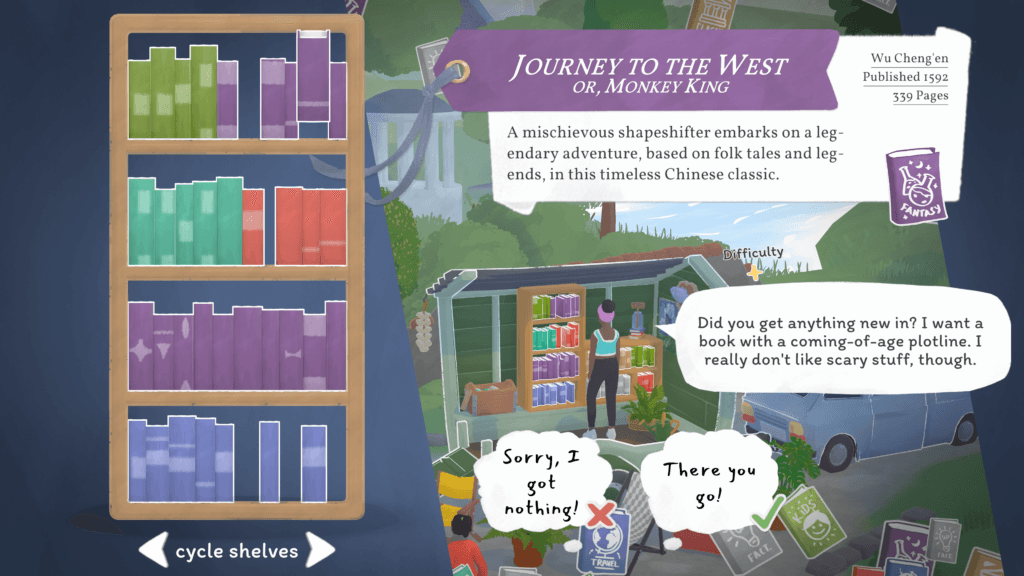
You meet regulars, students, retirees, creatives, each with their own preferences and quiet struggles. The game cleverly ties its storytelling to its mechanics: recommending a book becomes an act of empathy. When you get it right, the payoff isn’t just currency, it’s connection.
The use of real-world books, alongside fictional ones, adds authenticity, grounding interactions in recognizable literary touchstones.
That said, the narrative can feel a bit light in execution. Some arcs don’t fully land, and players looking for a strong, linear storyline may find it lacking.
But that’s also the point. Tiny Bookshop isn’t telling you a story, it’s letting you participate in one.
The Subtle Art of Selling Stories
The gameplay loop is straightforward:
- Stock books across genres
- Arrange your shop layout and decorations
- Open for the day and serve customers
- Recommend books based on their preferences
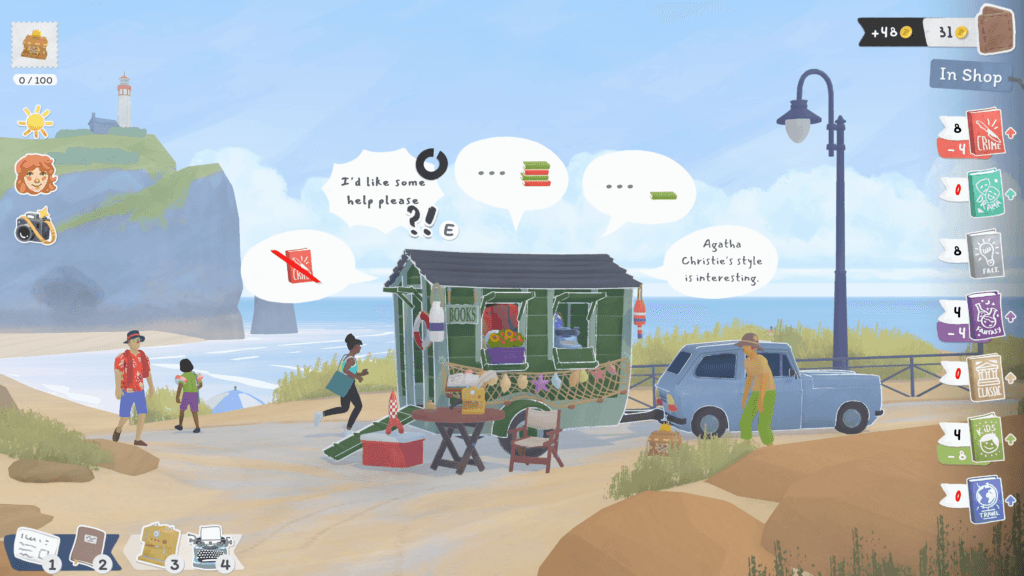
What elevates this loop is nuance. Customers don’t just ask for “a mystery novel”, they describe moods, themes, or vague interests. You’re expected to interpret those cues, scan your inventory, and make an informed recommendation.
It’s essentially a puzzle system disguised as retail.
Decorations also matter more than you’d expect. Placing certain items can boost sales for specific genres, subtly encouraging experimentation and personalization.
The pacing is deliberately gentle. Customers wander in slowly, there’s no penalty for failure, and each in-game day wraps up quickly. This lack of pressure is both a strength and a limitation.
Because while the game maintains engagement through its systems, repetition does creep in over time, a common critique echoed across reviews.
Still, the loop remains satisfying because it’s rooted in intention. You’re not grinding, you’re curating.
A Well-Stocked Shelf
✅ Pros
- Thoughtful, relaxing gameplay with meaningful player agency
- Unique recommendation mechanic that blends puzzle-solving with storytelling
- Strong sense of atmosphere and place
- Creative shop customization with functional impact
- No-stress design makes it highly accessible
❌ Cons
- Repetitive gameplay loop over extended sessions
- Narrative lacks dramatic weight for some players
- Limited mechanical complexity compared to larger sims
- Slow pacing may not appeal to all
Final Verdict – A Small Game With a Big Heart
Score: 4.5 / 5
There’s a tendency to underestimate games like Tiny Bookshop. It doesn’t have the scale of AAA titles or the mechanical complexity of hardcore sims. But that’s precisely why it stands out.
It understands something many games forget: engagement doesn’t always come from challenge. Sometimes, it comes from care.
By turning the act of recommending a book into its core mechanic, Tiny Bookshop taps into something deeply human, the desire to connect through stories. It’s a game about understanding people, not systems.
Yes, it’s repetitive. Yes, it’s understated. But it’s also quietly effective.
If you’ve ever loved a book enough to recommend it to someone else, Tiny Bookshop will feel like coming home.
This review of Tiny Bookshop is based on the PS5 version, with a code provided by the game’s publishers.
About The Author