Avinash Rohra
 ![Kusan_ City of Wolves - Key Art [Landscape]](https://thequestunlocked.com/wp-content/uploads/2026/08/Kusan_-City-of-Wolves-Key-Art-Landscape-scaled.jpg)
There is a particular kind of frustration that only a good arcade game can create.
You know you were better than that.
You know exactly where you went wrong. Maybe you rushed the gunman. Maybe you mistimed the parry. Maybe you got greedy because the room was almost clear and decided that, yes, obviously, you could punch that final enemy instead of taking the sensible route.
Then you’re dead.
So you try again.
Kusan: City of Wolves understands this relationship between failure and obsession better than most games I’ve played this year. It is the kind of game that can turn a five-minute encounter into half an hour of increasingly precise experimentation, not because it is randomly cruel, but because it keeps dangling the possibility that you could have done it perfectly.
That is important because, at first glance, Kusan looks like it has arrived several years too late.
A top-down, pixel-art action game where everyone dies in one hit? A grimy neon city? Anthropomorphic characters? Fast, bloody encounters? If Hotline Miami hadn’t already burned this particular image into the collective gaming consciousness, Kusan: City of Wolves would have had considerably less explaining to do.
Instead, CIRCLEfromDOT has made a game that wears its influences openly but does considerably more with the formula than its first impression suggests.
And after spending my time with the PC version, I came away with a surprisingly simple conclusion: Kusan isn’t trying to replace Hotline Miami.
It’s trying to give this style of game somewhere else to go.
I have a particular weakness for games that make failure feel like information.
There is something deeply satisfying about dying because you made one mistake, immediately understanding what that mistake was, and restarting before you’ve even had time to get annoyed about it. Kusan: City of Wolves is built almost entirely around that relationship between failure and improvement. Its enemies can kill you in a single hit, its stages are designed around increasingly efficient execution, and its scoring system practically dares you to stop playing once you’ve merely survived.
That makes Kusan an obvious game to compare with Hotline Miami. The top-down perspective, one-hit kills, rapid encounters and emphasis on replaying stages until you understand them are all familiar territory. But CIRCLEfromDOT has given the formula its own set of mechanics, particularly through Jin’s War Hand, Quantum Knife, firearms, parries and the Tech-trix upgrade system.
The result is a game that doesn’t need to escape its influences to justify its existence. It simply needs to execute them well.
For the most part, it does.
What Is Kusan: City of Wolves?
Kusan: City of Wolves is a hardcore top-down action shooter developed by CIRCLEfromDOT and published by PQube. You play Jin, a former soldier who now works as a gun-for-hire, as a job involving a girl named Haru draws him into a much larger conflict. Haru possesses immense and uncontrollable power, while the game’s setting is a near-future city consumed by violence and corruption.
The game presents its world through a distinctive graphic-novel aesthetic, combining pixel-art environments with comic-book-style storytelling. Its cast of anthropomorphic characters gives the setting an unusual identity, while the neon-lit urban environments create the kind of exaggerated crime-noir atmosphere that immediately tells you this is not going to be a particularly cheerful afternoon for anyone involved.
The premise is straightforward enough to get the action moving. Jin is tasked with protecting Haru, but the circumstances surrounding her quickly become connected to his past and the wider conflict taking place around them. It is a familiar setup for a game about a former soldier caught between competing forces, but Kusan is far more interested in putting Jin through increasingly violent encounters than it is in reinventing the action-thriller template.
And honestly, that’s fine.
The story exists to give the violence context. The combat is where the game expects you to spend your attention.
The Hotline Miami Comparison Is Inevitable. It Is Also Incomplete.
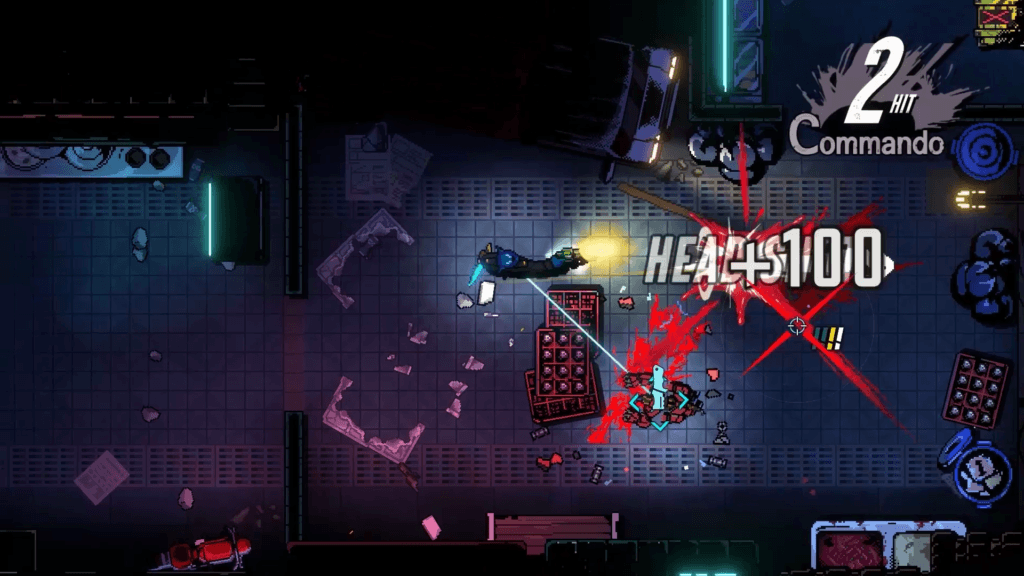
There is no escaping Hotline Miami when talking about Kusan: City of Wolves. The comparison is baked into the premise: top-down perspective, extremely fast encounters, one-hit deaths and a design philosophy built around learning from repeated failure. But stopping there would miss what makes Kusan interesting.
Jin’s arsenal gives him several ways to approach an encounter. The War Hand provides a powerful melee option, the Quantum Knife can be thrown at enemies, and firearms allow him to control fights from a distance. Then there are the parries, which allow Jin to counter incoming melee attacks and even redirect bullets. That last mechanic changes the character of combat considerably.
A bullet isn’t always something you need to avoid. With the right timing, it becomes something you can turn against the person who fired it. The same principle applies to melee attacks, creating moments where aggression and defence become almost indistinguishable.
This gives Kusan a pleasingly dangerous combat rhythm. You’re constantly making small decisions about distance, timing and weapon choice. Do you take the safer shot? Close the gap? Throw the knife? Risk the parry? Use the War Hand?
Because mistakes are so heavily punished, these decisions matter.
The individual mechanics aren’t especially difficult to understand. Combining them while several enemies are trying to kill you is another matter entirely.
That’s where Kusan starts to feel less like a conventional shooter and more like a combat puzzle being solved at speed.
The Real Progression Is Learning the Levels
Kusan contains 54 stages spread across four chapters, and completing them is only the beginning if you’re interested in mastering the game.
Each stage has a performance ranking based on factors including time, kills, combos, style, bravery, parries and bonuses. The highest ranks demand much more than simply reaching the end alive. They ask you to understand the stage well enough to execute it efficiently.
This is where the arcade philosophy becomes particularly effective.
There is a difference between knowing how to finish a level and knowing how to finish it well.
The first time through, you’re mostly concerned with survival. You’re learning where enemies are, what they can do and which attacks are likely to ruin your run. Once you’ve internalised that information, the objective changes. You start looking for a cleaner route. A faster kill. A better opportunity to maintain a combo. A moment where a parry can save time instead of simply saving your life.
The game doesn’t need to tell you to replay a stage. The ranking system does that job for it.
And because death sends you back into the action quickly, failure rarely becomes a lengthy interruption. You know what went wrong, and the next attempt is already waiting.
That loop is Kusan’s greatest strength.
There is no conventional difficulty selection, either. The game asks you to meet its challenge on its terms, which will undoubtedly make it less approachable for players who prefer adjustable difficulty. But that uncompromising structure is also what gives the scoring and mastery systems their purpose.
Build Your Wolf, One Tetris Block at a Time
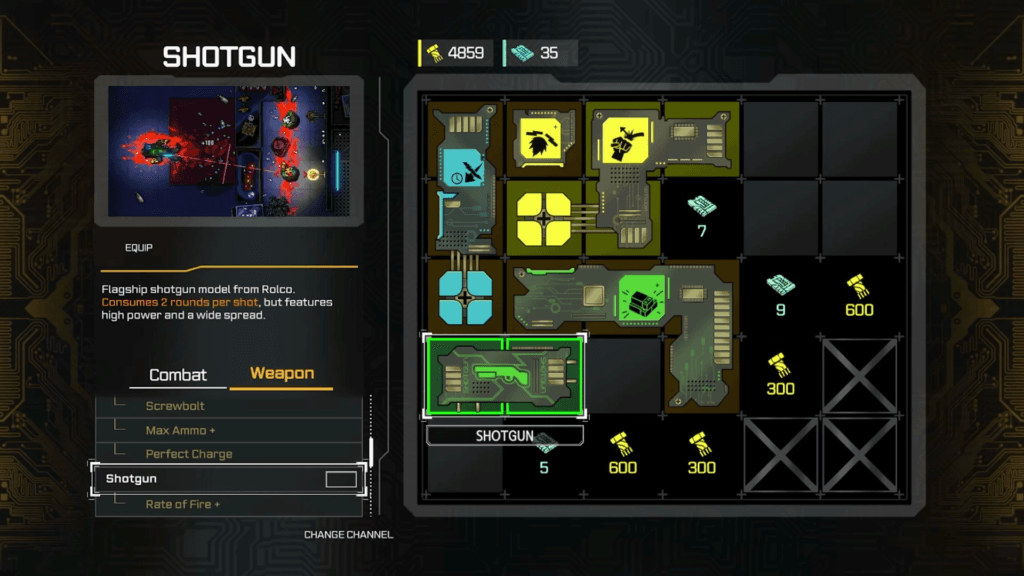
The Tech-trix system is one of the game’s smarter ideas.
Instead of using a traditional skill tree, Kusan gives you a grid into which abilities are fitted using pieces that resemble Tetris blocks. The available space is limited, meaning that choosing what you want equipped becomes a small puzzle of its own.
That would be interesting enough if the system only dealt with passive bonuses, but the abilities can also affect how Jin’s equipment functions. The result is a progression system that can change how you approach combat rather than simply making numbers larger.
It’s an especially good fit for Kusan because the rest of the game is already asking you to think in terms of solutions.
A level is a puzzle.
Your loadout is another puzzle.
The fun comes from finding a combination that makes both work together.
The system does become less compelling later in the campaign. Once you’ve accumulated enough upgrades, the game’s currency has less importance, and the Tech-trix configuration becomes more significant than the resources you’re spending to acquire it. It doesn’t break the progression system, but it does mean that the sense of discovery surrounding upgrades is stronger earlier in the game.
Still, this is considerably more interesting than simply watching a skill tree slowly fill itself in.
A Stylish World That Doesn’t Always Know What to Say
Visually, Kusan has a strong identity.
The pixel-art environments and graphic-novel presentation work together particularly well. Comic-style sequences give the story a sense of motion and personality, while the game’s urban environments provide a suitably grim backdrop for Jin’s increasingly violent journey.
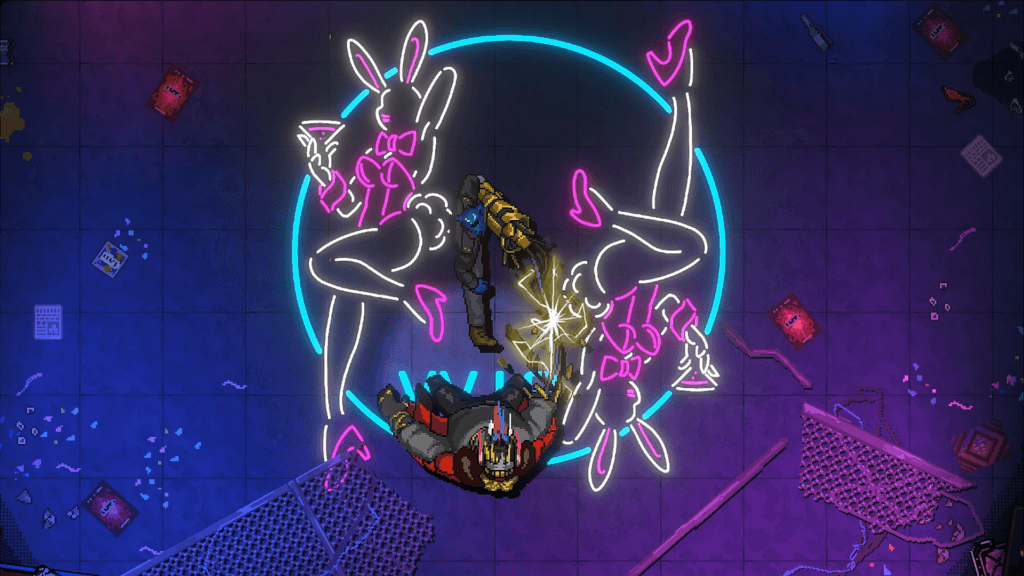
The anthropomorphic cast could easily have been a superficial gimmick. Instead, the characters fit naturally into the game’s exaggerated visual language. Kusan knows exactly what kind of world it wants to create, and it rarely feels embarrassed by its own excesses.
The writing is less assured.
The central premise is easy enough to understand, but the narrative becomes more difficult to follow as additional characters, conflicts and pieces of Jin’s past enter the picture. The dialogue and exposition don’t always communicate information as cleanly as the game’s visual design does.
That is frustrating because the presentation suggests a story with considerably more confidence than the writing consistently demonstrates.
The comic-book format is a great fit for the material. I just wish the story took better advantage of it.
The Soundtrack Doesn’t Play It Safe
Kusan’s soundtrack comes from Korean hip-hop artist Loptimist, and its sound gives the game another element of personality.
Rather than leaning entirely on the electronic style associated with many games in this particular lineage, the soundtrack uses prominent 808-heavy production and Korean hip-hop influences. It suits the game’s urban setting and helps establish an identity separate from its obvious inspirations.
Whether it always provides the same immediate rush as the combat is another question.
There are moments when the music and action lock together beautifully, but I occasionally found myself paying more attention to the sounds of the combat itself—the impact of an attack, the rhythm of a successful sequence, the sharp punctuation of a parry—than to the music playing underneath it.
That’s not necessarily a criticism of Loptimist’s work. It’s more a reflection of where Kusan‘s strongest sensory feedback comes from.
The combat has its own rhythm.
And when you’re playing well, it’s a pretty difficult rhythm to beat.
Pros & Cons
Pros
- Fast, demanding top-down combat
- War Hand, Quantum Knife and firearms provide meaningful variety
- Bullet and melee parries add depth to encounters
- 54 stages provide substantial room for mastery
- Detailed scoring system encourages replay
- Tech-trix offers a clever grid-based progression system
- Strong pixel-art and comic-book presentation
- Distinctive Korean hip-hop soundtrack
Cons
- Upgrade economy becomes less meaningful later in the campaign
- Some mechanics could be explained more clearly
Final Verdict
Final Score: 4/5
The easiest criticism to make of Kusan: City of Wolves is that it looks like a Hotline Miami game where somebody replaced the masks with anthropomorphic animals.
It is also the least interesting criticism to make.
The influence is obvious, but CIRCLEfromDOT has done enough with the formula to make Kusan worth experiencing on its own terms. The War Hand, Quantum Knife, firearms and parry mechanics give the combat more possibilities than its first impression suggests, while the Tech-trix system adds a genuinely interesting layer of preparation.
But the game’s real achievement is the way it makes failure feel useful.
You die. You understand why. You restart.
The second attempt is better because you know something you didn’t know thirty seconds ago. Eventually, an encounter that initially felt chaotic starts becoming predictable. Enemy positions become familiar. Your movement becomes more deliberate. The parry you kept missing suddenly becomes something you perform without thinking.
That transition – from struggling with a level to understanding it – is the reason Kusan works.
It isn’t trying to make you feel powerful by giving you increasingly ridiculous numbers. It wants you to become more capable as a player.
The uneven storytelling and later progression prevent Kusan: City of Wolves from reaching the same level of precision outside its combat. But when the game is asking you to enter a room, make decisions under pressure and execute them perfectly, it is difficult to resist.
There is a wonderful old-school quality to that.
Kusan doesn’t need to reinvent the top-down shooter. It simply needs to remind you why these games are so addictive in the first place.
You don’t keep restarting because the game is forcing you to.
You keep restarting because you know you can do it better.
This review of Kusan : City of Wolves is based on the PC Version, with the code provided by the Publisher/PR Agency.
About The Author