Avinash Rohra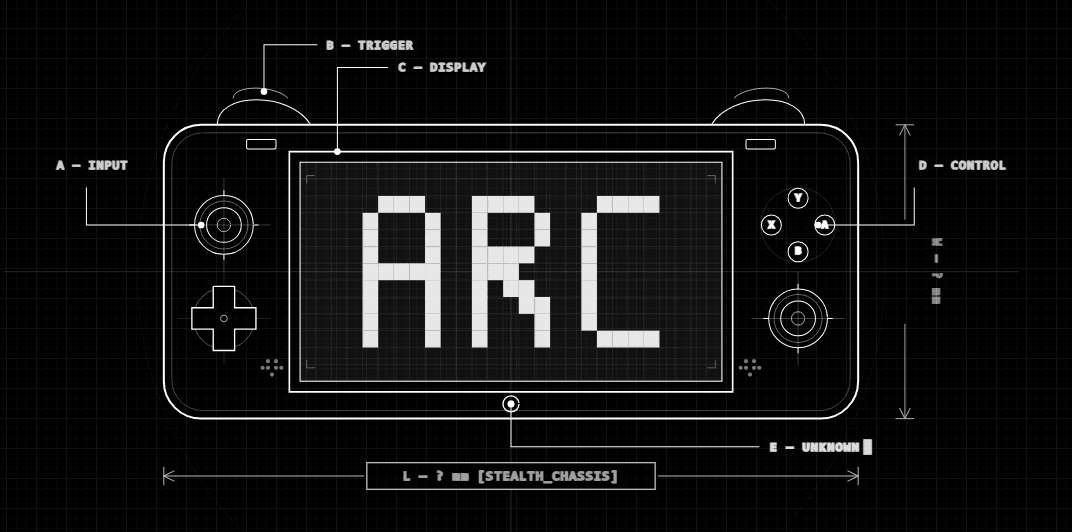
There’s a particular kind of ache that comes from wanting a Steam Deck in India. You do the currency math, you check the import duties, you look at the exchange rate again like it might have changed in the last ten minutes, and then you close the tab. For a country that generates some of the largest mobile gaming numbers on the planet, dedicated handheld hardware has always felt like a party we were watching through a window — Valve, Nintendo, ASUS, Lenovo, all throwing devices at a global market that only sometimes remembers we exist.
That window just got a door.
Meet ARC
A new gaming hardware company called ARC has stepped out of Bengaluru with an unusually direct pitch: build a handheld console for Indian gamers, not just sell one to them. The company is co-founded by Jobin Joseph and Kaustubh K. Jadhav, two self-described lifelong gamers who’ve decided that the biggest gap in India’s gaming landscape isn’t talent, or appetite, or even money – it’s that nobody has bothered to design hardware around how Indians actually play.
Joseph framed the company’s founding idea around a simple observation: India has built one of the world’s largest gaming communities, yet premium gaming has remained out of reach for many players, and ARC exists to close that distance. Jadhav’s framing leans more communal – the company’s vision from the start has been to build the platform with the community rather than simply for it, with early waitlist members positioned as collaborators shaping the ecosystem rather than customers waiting for a finished product.
ARC’s own account of its founding, tucked into its About page, is less pitch deck and more shared memory. It describes a generation of Indian gamers who grew up on the wrong side of the console – kids at a friend’s house, waiting their turn, learning entire games by watching rather than playing, memorising maps and boss patterns for hardware they never owned. The company’s framing is that this workaround was the fandom — that being a gamer in India was never really about owning the device, it was about refusing to let the lack of one get in the way. ARC’s stated bet is that this same generation, now with disposable income and no local option built for them, is the market nobody has properly served.
What’s actually on the table
ARC isn’t just teasing a device – it’s teasing an entire stack, and it now has a name: the ARC X1. Per the company’s own messaging, the plan includes:
- Purpose-built hardware – a handheld designed around ergonomics and performance from the ground up, not a repurposed phone chassis, co-developed alongside its own operating system rather than bolted together after the fact
- OwlOS – a proprietary, AOSP-based operating system built specifically for controllers and portable play (more on this below)
- Integrated software services – first-party tools layered on top of the OS
- A community-led platform – the piece ARC keeps returning to, framing early adopters as collaborators rather than customers
What ARC has not revealed yet is arguably more interesting than what it has: no chipset, no RAM or storage figures, no display size, no battery capacity, no pricing, and no launch window. What it has revealed, in unusual depth for a pre-launch startup, is the thinking behind its software – which makes this one of those rare hardware reveals where the OS philosophy arrived before the spec sheet did. The waitlist at playarc.gg is, right now, the primary public-facing front door – a bet that curiosity and national pride can carry a hardware company further than benchmarks can, at least for now.
OwlOS: the part that actually separates ARC from “another Android handheld”
The most substantial reveal so far isn’t the hardware – it’s the operating system underneath it. ARC has detailed OwlOS, and the pitch is deliberately not “Android in a gaming case.” The company’s own framing is that the underlying architectures every player currently relies on were never built with a handheld in mind — desktop operating systems were designed for computers, mobile ones for touchscreens, traditional consoles as closed boxes — and that portable gaming needs a system built around controllers, efficiency and instant access instead of inheriting someone else’s assumptions.
The technical foundation is the Android Open Source Project, chosen for its ARM-native efficiency and its enormous existing developer ecosystem. But ARC is explicit that AOSP alone doesn’t understand physical controllers, sustained thermal loads, or game libraries – so OwlOS is being built as the missing layer on top, tuned specifically for how a handheld actually behaves under load.
In practice, OwlOS is designed around three ways to play:
- Natively – Android and ARM-based titles running directly on-device
- Through the cloud – supported cloud-gaming services for titles beyond local hardware limits
- Remotely – streaming from a compatible PC or console elsewhere in the house
ARC also says it’s actively researching further compatibility layers to bring more of the PC library to ARM hardware – an ambitious, still-unproven claim worth watching rather than taking at face value.
Because OwlOS is being developed in tandem with ARC’s own hardware rather than as a generic layer for third-party devices, the company says the system can make real-time calls most handhelds can’t – reading power draw, thermals, the active game, and even a player’s target frame rate to adjust performance and battery life on the fly.
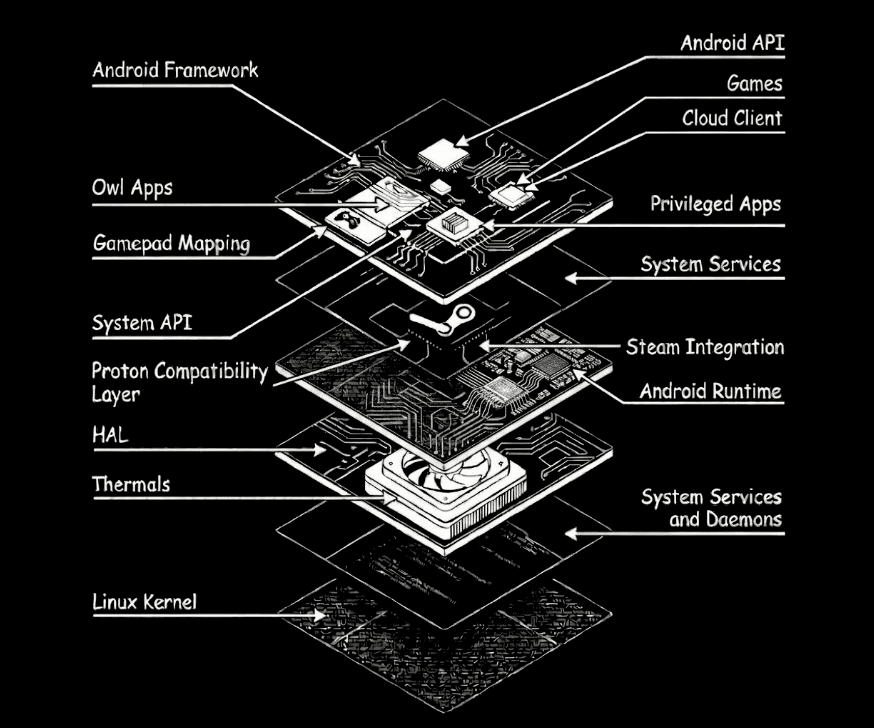
ARC’s own architecture diagram lays the stack out in full, and it’s a far more ambitious build than “Android with a controller skin.” At the base sits a Linux kernel, with system services, daemons, thermal management and a hardware abstraction layer handling the low-level plumbing. Above that is the layer that actually justifies OwlOS as its own product: a dedicated Android Runtime running alongside a Proton compatibility layer and direct Steam integration – the same category of technology Valve uses to run Windows games on Steam Deck’s Linux-based SteamOS. Only above that does the stack surface into an Android Framework, gamepad mapping, ARC’s own “Owl Apps,” and finally the games, cloud client, and privileged apps a player actually sees.
If that holds up in practice, it means OwlOS isn’t choosing between “Android handheld” and “PC gaming handheld” – it’s attempting both on the same device, natively, cloud-streamed, and via Windows-game compatibility, at once. It’s also worth a note of caution: Proton is built and battle-tested for x86 hardware, and getting it to translate x86 Windows games onto ARM silicon – which is what an Indian-built, cost-conscious handheld would likely use – is a considerably harder engineering problem than running Proton on the x86 chips Steam Deck uses. It’s an exciting claim. It’s also one we’d want to see running an actual game before taking as settled.
The stated long-term ambition goes well past the ARC X1 itself: a unified player identity across future devices, a developer toolset for optimising games for ARM and controllers, and – notably for our readers – a discovery layer built specifically to surface independent and regional titles that mainstream storefronts tend to bury.
Whether any of that survives contact with a real product is the open question. But it’s a considerably more serious software thesis than most first-time hardware startups bother articulating before they’ve shipped a single unit.
The Mission statement, for what it’s worth
ARC frames its own purpose in fairly unadorned terms: making great gaming accessible so no player has to compromise to experience it, with a stated vision of India eventually becoming home to the world’s largest community of players. Mission statements are cheap and every startup has one – but paired with an actual OS architecture and a named device, this one at least has something to be held accountable to.
Why this is a bigger swing than it looks
Building consumer hardware is already one of the least forgiving businesses in tech – engineering, manufacturing, global component sourcing, all stacked against margins that punish every mistake. Doing it as a first-time Indian startup, in a segment where the Steam Deck, ASUS ROG Ally, Lenovo Legion Go, and MSI Claw have already set a punishingly high bar for what “good” feels like in your hands, is close to reckless. It’s also exactly the kind of reckless this space has been missing.
The economics explain why the gap exists in the first place. Premium imported handhelds routinely land in India priced well into the ₹45,000–₹90,000 range once duties and distribution markups are factored in – a price that quietly excludes most of the audience that would actually want one. If ARC can thread the needle between real performance and a price point built for the Indian market rather than adapted for it, it changes the calculus for an entire generation of players currently choosing between “import it” and “just play on the phone.”
That’s the real story here – not a console, but a test of whether a market this large can finally get hardware built for its own economics instead of receiving global leftovers at a markup.
The part press releases usually skip
What’s notable about ARC’s rollout isn’t just what it’s building – it’s how openly it says it’s building it. Alongside the announcement, the team has started publishing a documentary-style series across YouTube and Instagram, walking through the unglamorous reality of standing up a hardware brand from scratch – the kind of behind-the-curtain content most console makers wait years, if ever, to show. For a category where consumer trust is usually earned through a decade of retail shelf presence, choosing radical transparency from day one is either a smart trust-building move or a very public tightrope – likely both.
Joining the waitlist reportedly comes with more than a place in line: early product updates, first look at launch news, access to community initiatives, and priority purchase access once the device goes on public sale.
Our take
We’ve spent years reviewing handhelds that were never built with us in mind – devices where “global launch” quietly meant “everywhere except here,” or where “available in India” meant paying a premium for the privilege of being an afterthought market. ARC’s pitch is the first one in a while that doesn’t ask Indian gamers to be grateful for scraps.
Whether ARC can actually deliver — competitive silicon, a genuinely useful OS, a price that doesn’t just re-create the same ₹60,000 wall it’s trying to tear down — is a question only a shipped product can answer. But the fact that the question is even being asked, by a team of two co-founders willing to livestream the mess of building it, is the kind of story TQU exists to cover.
We’ll be watching the waitlist rollout closely. If you want in before specs and pricing drop, registrations are open now at playarc.gg.
The Quest Unlocked will continue tracking ARC’s development diaries and update this story as hardware details emerge.
About The Author