Avinash Rohra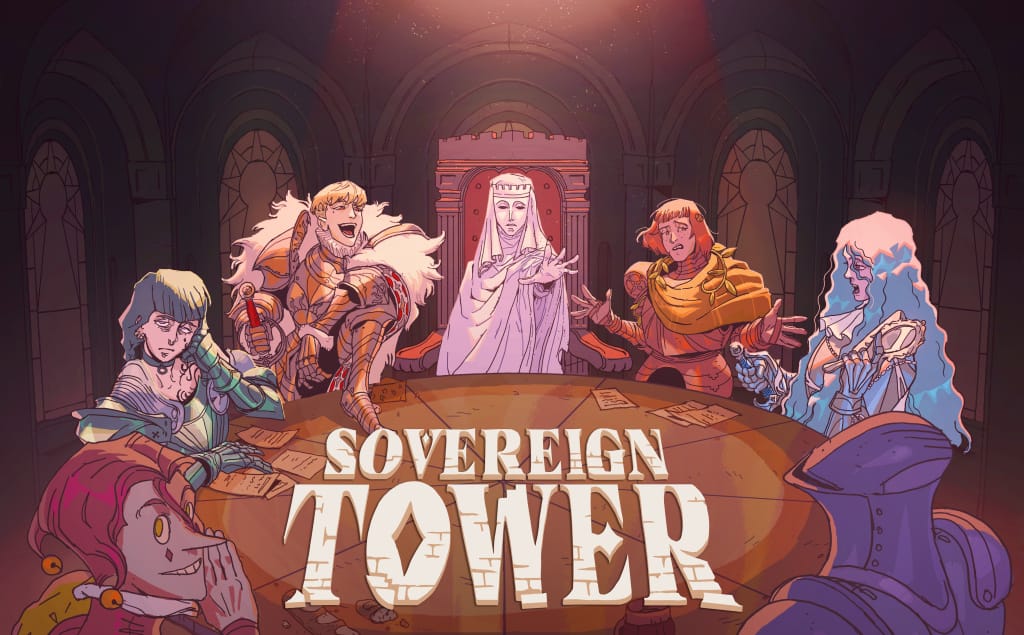
Most games built around difficult choices eventually expose the machinery behind them. Pick the generous response and somebody approves. Choose the ruthless option and another number drops. Reload if you dislike the consequences. Sovereign Tower understands that players already know how this works, so instead of pretending otherwise, it drags the reload itself into the story.
That decision changes almost everything.
WILD WITS GAMES has built a medieval fantasy RPG around the uncomfortable business of ruling people rather than fighting for them. You recruit Knights to your Round Table, send them to deal with problems across the kingdom, balance the interests of competing groups and decide how much damage you are prepared to accept when there is no neat solution. Then, when things go badly enough, there is another option. Beneath the Tower waits a demon capable of helping you turn back time.
The clever part is what happens after you do.
A Crown You Were Never Supposed to Wear
Sovereign Tower opens with an appropriately strange premise. Its protagonist is a wandering leper who gains access to an ancient Tower and unexpectedly becomes the Sovereign. From there, Arthurian fantasy becomes less about heroic quests performed personally and more about deciding who should be sent to perform them.
The Round Table gradually fills with Knights, each useful for different reasons and troublesome for others. They are measured through five stats: Strength, Agility, Charisma, Magic and Wit. Quests call for different combinations of those qualities. Successful assignments provide experience and allow individual stats to improve. Failure can cost health, lead to death or damage a relationship badly enough that a Knight leaves.
That last part matters more than it first appears.
Levelling somebody does not sand away their personality. A Knight can become better suited to a task numerically while still resenting what you have asked them to do. The cleanest statistical solution is therefore not always the one I wanted to take. Sovereign Tower is at its most interesting when the numbers point in one direction and the person attached to those numbers makes me hesitate.
There is no conventional player-controlled combat carrying the RPG side of the game. The tension comes from assignment, judgement and consequence. It sounds passive on paper. In practice, deciding who should deal with a problem becomes its own form of strategy because the outcome can ripple into relationships and later events.
Running a Kingdom Means Disappointing Someone
The larger political structure makes those decisions harder to isolate.
The People, Nobles, Merchants, Scholars and Mystics all have interests that can rise or fall depending on your decisions. Relationships with neighbouring realms can also shift. Recruitment choices matter outside the immediate usefulness of a new Knight, while intervention in political disputes can alter how other rulers respond later.
Romance sits inside the same web. It is not presented as a disconnected reward track where enough favourable conversations simply unlock a scene. Relationships can influence character outcomes, which fits the broader design philosophy remarkably well. Sovereign Tower keeps asking you to consider people as more than tools while simultaneously forcing you to use them as exactly that.
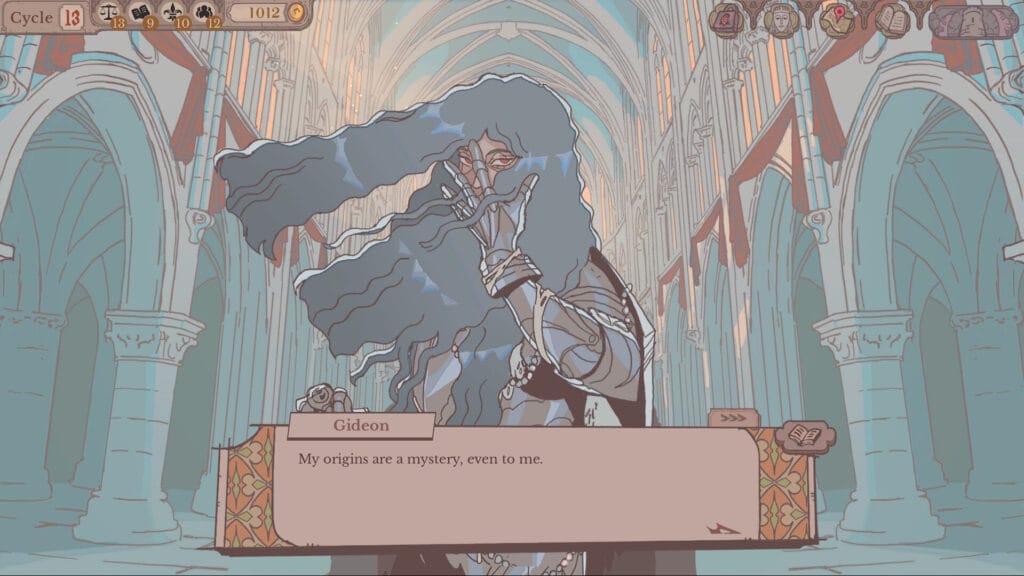
The hand-drawn presentation supports this character focus. Illustrated portraits carry much of the interaction, and the visual-novel structure gives the cast room to make an impression without turning the game into a traditional exploration RPG. The Tower and its menus are where most of the ruling happens. This is a court management game wearing Arthurian robes, and it is better for being honest about that.
Failure Is Information
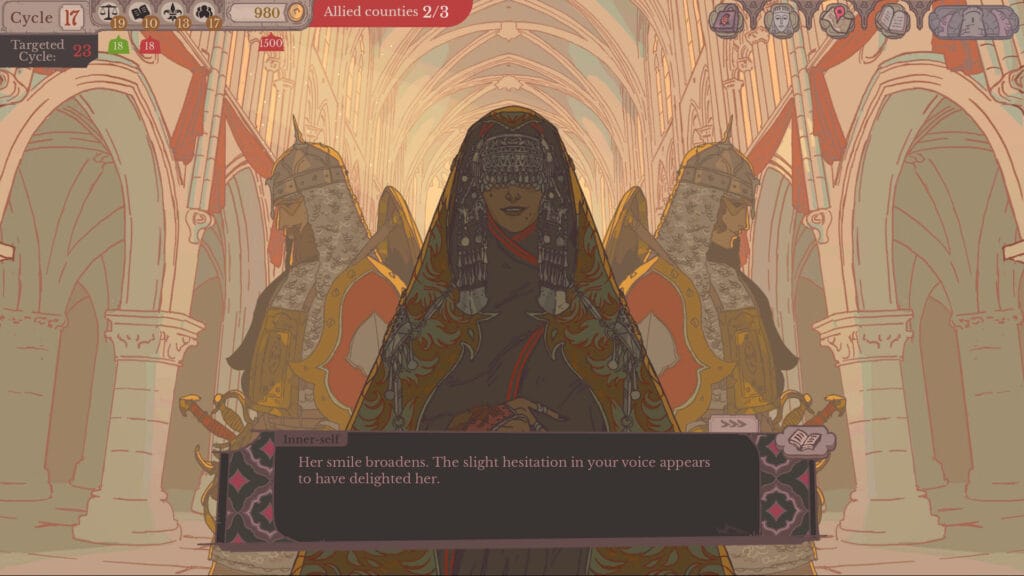
The rewind mechanic is where Sovereign Tower finds its strongest idea.
Turning back time does not simply erase a bad result. Information survives with you. Knowledge gained during one version of events can open different responses when you return to an earlier point, allowing the Sovereign to act on details they should not yet know.
That makes failure useful.
I stopped looking at a failed timeline as something that needed correcting and started treating it as reconnaissance. A disastrous outcome can reveal information that changes how the same situation unfolds the next time. The game therefore gives replaying a purpose beyond chasing the cleanest branch.
It also creates a problem the longer you engage with it. Retracing familiar events can become tiring when you are attempting to reach a very specific outcome. The rewind system feels sharpest when previous knowledge changes the context of a decision. It is less interesting when you already understand the situation and simply need to work through familiar material again.
The Omni-Forward option helps when revisiting dialogue, although it cannot remove the repetition inherent in retracing a specific route.
Still, that is a trade I am willing to make because the alternative would weaken the game considerably. Sovereign Tower needs its mistakes to matter before it gives you permission to interfere with them.
Building More Than the Round Table
Progress expands beyond Knight statistics as the Tower develops. New annexes and services become available, including the Blacksmith’s Forge and the Witch’s Alchemy Room, while successful quests can provide items, relics and influence.
The real expansion, though, happens through the network of decisions surrounding those systems. Recruiting one person can change another relationship. Political choices can lock away later interactions. A romance can affect a character’s fate. Somebody who appears ideal for a mission can refuse to remain useful if repeatedly pushed against their nature.
That level of dependency makes experimentation appealing because there is no obvious route through the game that feels like the authorised one.
It also explains why Sovereign Tower works better when I resist the urge to optimise everything. Treating every decision as a puzzle with a perfect solution misses the point. Sometimes the interesting result is the damaged one.
The launch version did have problems beyond deliberate messiness. Players reported crashes around the Godot startup screen, repeated scenes and quest-state issues. WILD WITS responded with a steady run of post-launch updates, and patches through version 1.1.1 have addressed crashes, progression problems, romance inconsistencies, NG+ issues, quest logic and several character-state bugs. Patch 1.1.0 also added two new endings.
That continued support matters because some of the problems were not cosmetic. They interfered with the same branching logic on which the game depends. The current version is in a better place than the launch build, although the frequency of those fixes also shows how many edge cases a game this dependent on interconnected states can produce.
Pros
- The rewind mechanic turns previous knowledge into an actual narrative resource instead of functioning as an elaborate reload button.
- Knight personalities remain relevant after levelling, which stops progression from reducing characters to better numbers.
- Mission assignment creates meaningful strategy without relying on conventional combat.
- Political relationships and character interactions feed into the same decision-making structure.
- The hand-drawn portraits suit a game where character judgement carries so much weight.
- Branching outcomes give repeat runs a clear purpose when you are interested in seeing how different decisions reshape events.
- Continued post-launch updates have addressed a long list of progression, quest-state and quality-of-life problems.
Cons
- Repeated timelines can become laborious when pursuing one specific branch.
- The structure asks you to revisit familiar dialogue and events by design, even with Omni-Forward available.
- Some desired character outcomes can require working back through a complicated web of earlier choices.
Final Verdict – The Crown Is Heaviest After You Know Better
Score: 4.5/5
What I like most about Sovereign Tower is that rewinding does not make ruling easier in the way I expected. Knowing more can make a decision worse.
Once you understand what waits on the other side of a choice, ignorance is gone. Saving one person can mean accepting what happens elsewhere. Fixing a political mistake can alter a relationship you preferred in the previous timeline. You can return armed with information and still end up staring at two answers you dislike.
That is a far more interesting use of choice than simply hiding consequences behind dialogue boxes.
Sovereign Tower occasionally asks for patience, and its early post-launch state exposed some rough edges that its elegant artwork initially hides. The repetition inherent to rewinding will also test anyone determined to engineer a particular ending.
But those weaknesses sit around a remarkably coherent central idea. The Knights, factions and time manipulation all push in the same direction. Your job is not to create a kingdom where nothing goes wrong. It is to decide which version of events you are prepared to live with.
And when you finally turn back the clock, the hardest part is knowing exactly what you are changing.
This review of Sovreign Tower is based on the PC Version, with the code provided by the Publisher/PR Agency.
About The Author