Avinash Rohra
There’s a very specific kind of failure that only system-heavy roguelikes deliver. Not the dramatic kind. Not a boss fight. Just a slow collapse. One bad item pick. One awkward placement. One turn where your numbers don’t quite add up.
That’s where Fortune Seller gets you.
I went into this expecting something closer to a quirky shop sim. What I got instead was a tightly wound systems game where every decision compounds. You are not just selling items. You are solving spatial problems, building synergies, and trying to stay ahead of a game that is constantly pushing back.
And the moment your rent spikes and your build stops scaling, you feel it immediately.
Selling Your Way Out of Debt
At a surface level, the premise is simple. You run a gothic antique shop. Customers arrive. You sell them items. You try to make money.
But underneath that is a layered loop built around pressure.
You are:
- Managing a limited inventory
- Packing items into customer suitcases like a grid puzzle
- Using tarot cards and effects to scale value
- Trying to hit ever-increasing rent targets
Fail to pay, and your run ends.
That rising rent is not background flavor. It is the entire game. Every system feeds into it. Every mistake is measured against it.
System First, Atmosphere Second
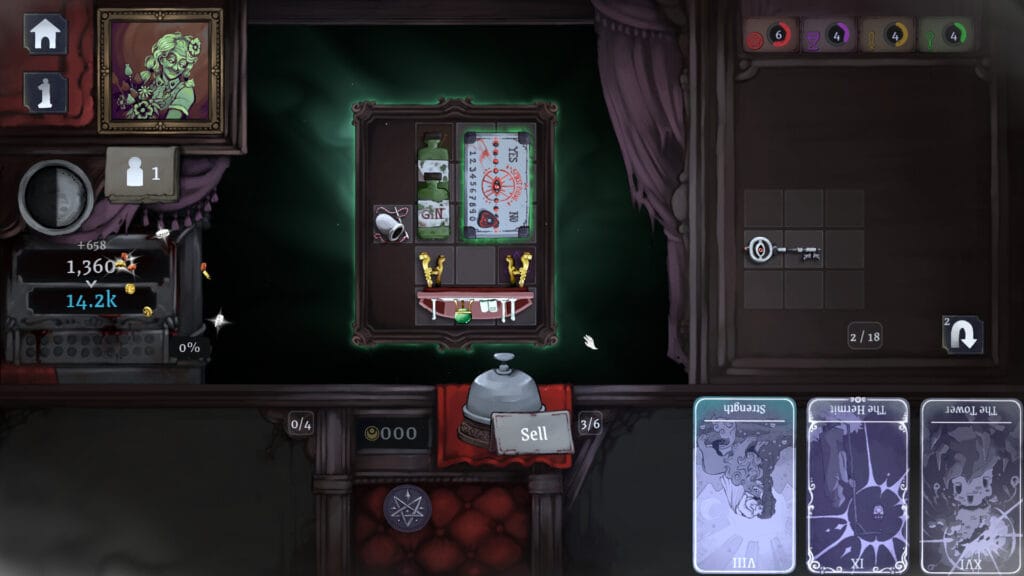
This is not a narrative-driven game in the traditional sense.
There is worldbuilding here. The setting leans into gothic and slightly Lovecraftian territory. Strange customers, cursed objects, a shop that feels off in a way you cannot quite pin down.
But the game does not push the story forward in a structured way. Instead, it builds tone through repetition and pressure. You are less a character and more a participant in a system that feels indifferent to your survival.
If you are looking for narrative payoff, this will feel thin. If you are here for systems, it works.
Where Everything Actually Happens
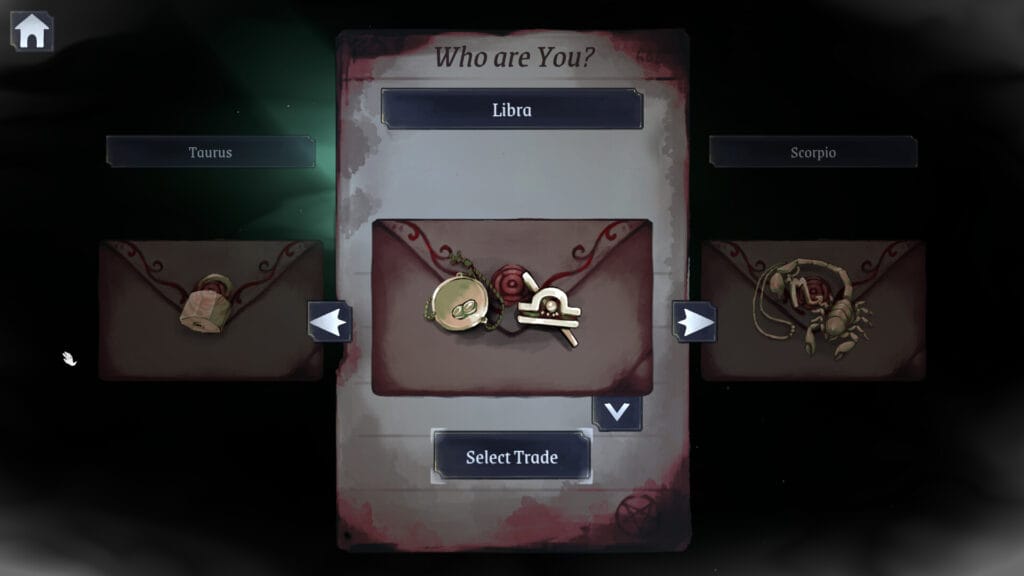
This is where Fortune Seller earns its keep.
Inventory as Puzzle
Every sale revolves around fitting items into a customer’s suitcase. Shapes matter. Space matters. Empty tiles cost you. Perfect fills reward you.
This is not cosmetic. It is the core challenge.
It sits in the same design lineage as Backpack Hero, where inventory organization becomes the game itself.
Synergies and Scaling
Items are not just objects. They belong to categories and interact with each other. Stack the right types together, and their value increases over time.This is where runs are won or lost. A good build snowballs. A bad one stalls out fast.At the end of each cycle, you draw tarot cards that modify your run. Some boost profits. Others change how items behave. Some introduce risk.You are not building a deck in the traditional sense, but you are shaping a system that compounds over time.The rent increases constantly. There is no plateau.This creates a dynamic similar to Luck Be a Landlord, where survival depends on scaling faster than the system itself.
And that pressure never lets up.
The Flow State
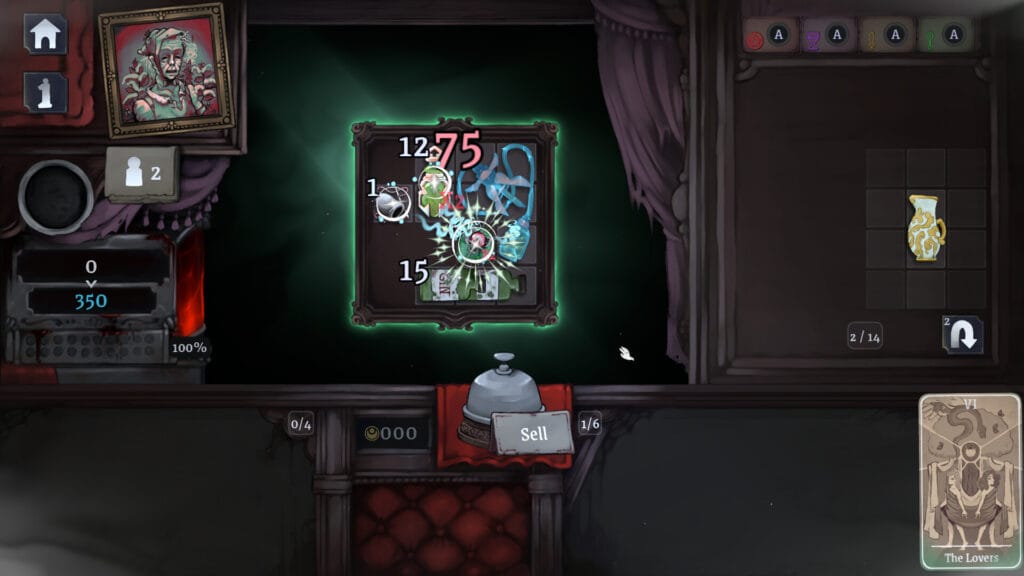
When everything clicks, Fortune Seller is excellent.
You start seeing patterns. You plan placements before items even appear. You build around synergies and commit to them. A good suitcase fill feels satisfying in a way that is hard to explain unless you have played something similar.
This is where the game earns its 4.2. The design is sharp. The systems talk to each other. It respects player intelligence.
But it is not clean.
The biggest issue is balance. The game can feel overtuned. Runs can collapse not because you played poorly, but because your build never scaled fast enough.
There is also a reliance on RNG. Tarot pulls, item availability, and customer flow can heavily influence outcomes. Sometimes you adapt. Sometimes you just lose.
And then there is pacing. Late runs can drag. When your strategy stalls, you feel every step of it.
Pros
- Deep, satisfying inventory-based gameplay loop
- Strong synergy systems that reward planning
- High replayability through builds and unlocks
- Cohesive gothic aesthetic and tone
Cons
- Difficulty curve can feel punishing and uneven
- RNG can override good decision-making
- Late-game pacing loses momentum
- Limited narrative engagement
Not a Cozy Shop Sim
This is for players who enjoy:
- Roguelikes with layered systems
- Optimization and efficiency puzzles
- Learning through failure
This is not for:
- Players looking for a relaxed management sim
- Narrative-first players
- Anyone who wants consistent, predictable runs
Final Verdict
Score: 4.2 / 5
Fortune Seller is one of those games that is easy to respect and occasionally hard to love.
The design is strong. The core loop is addictive. The inventory system is doing real work here, not just acting as a gimmick. When a run comes together, it feels earned.
But it is also a game that pushes hard. Sometimes too hard. The balance can feel unforgiving, and the reliance on randomness occasionally undermines the strategy it is trying to build.
Still, there is something compelling here. A system that clicks just often enough to keep you coming back, even after a failed run.
And that, more than anything, is why it works.
This review of Fortune Seller is based on the PC version, with a code provided by the game’s publishers.
About The Author