Saint Slayer: Spear of Sacrilege Review – Castlevania’s Cruel Old Lessons Still Have Teeth
 Avinash Rohra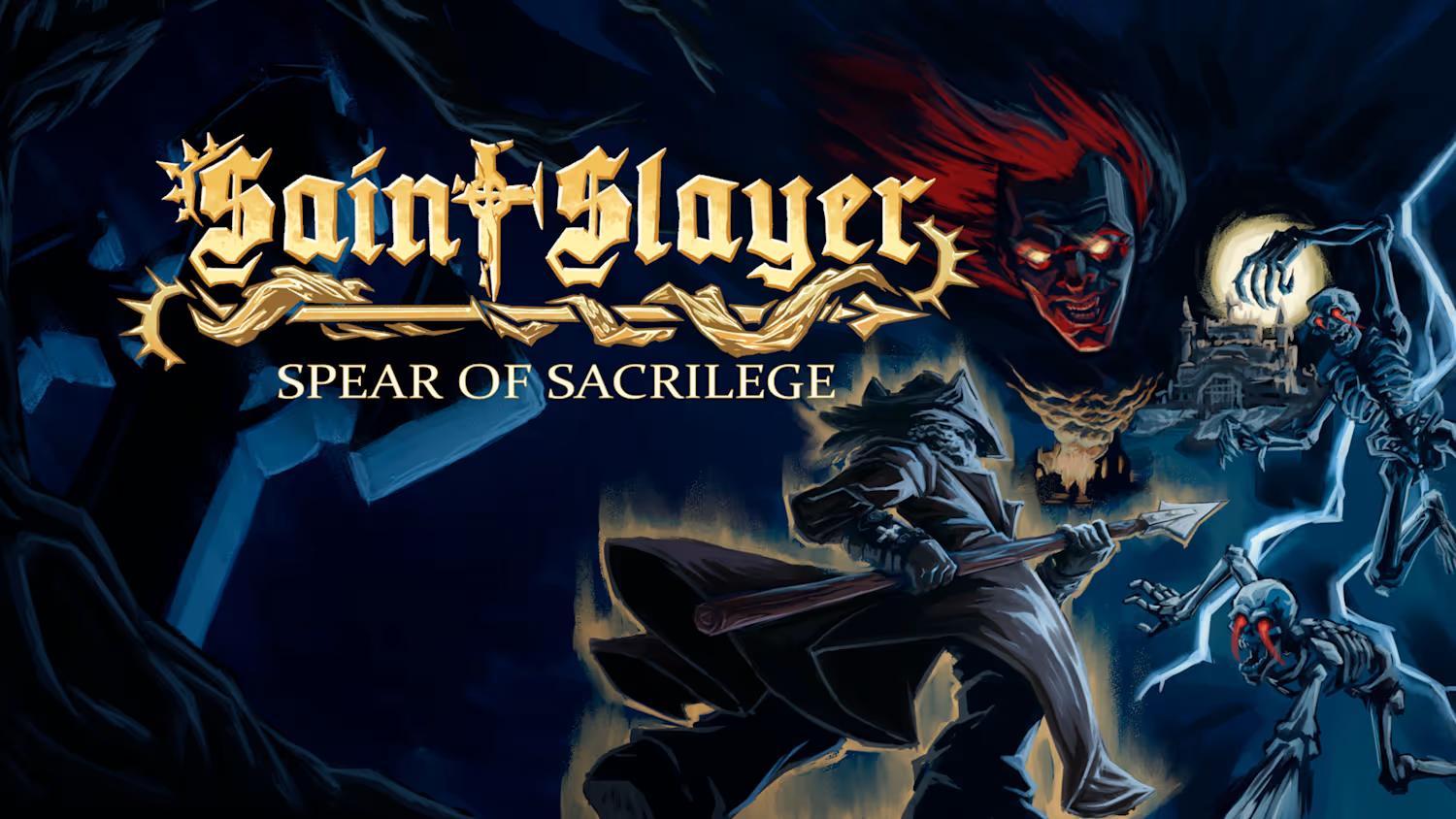
There is retro-inspired, and then there is Saint Slayer: Spear of Sacrilege, a game that occasionally seems offended by the last thirty years of quality-of-life improvements.
Lillymo Games has built its 2D action platformer around the vocabulary of NES-era Castlevania, right down to committed jumps, knockback capable of throwing Rudiger into a pit and stages that expect memorisation rather than improvisational heroics. That makes the opening stretch on PS5 slightly confrontational. My modern instincts kept asking for more mid-air correction and another chance after a mistake. Saint Slayer kept answering with the beginning of the stage.
I eventually stopped arguing.
That stubbornness is also what makes Saint Slayer work. Its limitations establish rules that enemies, hazards and level layouts can exploit, and learning those rules turns frustration into a satisfying process of shaving mistakes from each attempt. It is old-fashioned without becoming a hollow nostalgia exercise, even if its dedication to the period occasionally crosses the line from charmingly cruel to simply exhausting.
1698 Was Apparently Having a Bad Enough Year Already
Saint Slayer begins in 1698, after the War of the Grand Alliance. Rudiger is a former soldier who has traded war for farming when Father Pacer, a power-mad priest, begins violently pursuing Catholic relics throughout the Holy Roman Empire. Rudiger’s confrontation with him eventually leaves our reluctant hero carrying the Holy Spear himself.
From there, Lillymo sends you through 21 stages and 7 boss encounters, with the campaign also playable in two-player co-op.
The story deserves considerably more attention than my first impression suggested. Saint Slayer has an actual cast, conversations, optional interactions and religious mythology running underneath the platforming. Pacer’s hunt for relics gives the Catholic imagery a purpose beyond simply recreating the gothic mood of Castlevania, while Rudiger’s background gives the man holding the spear a little more substance than the tiny pixel protagonist initially lets on.
NPC encounters, shops and optional interactions flesh out the setting further, and the choices you make along the way matter. Saint Slayer allows Rudiger to help or harm people and property, with those decisions feeding into different endings. It gives repeat playthroughs a narrative reason to exist alongside score chasing and finding things you previously missed.
The writing also knows when to loosen its collar. For all the demons, relics and blood, Saint Slayer isn’t relentlessly solemn. Its sense of humour prevents the religious horror from becoming self-important without reducing the setting to parody.
A Spear Is More Useful Than You’d Think
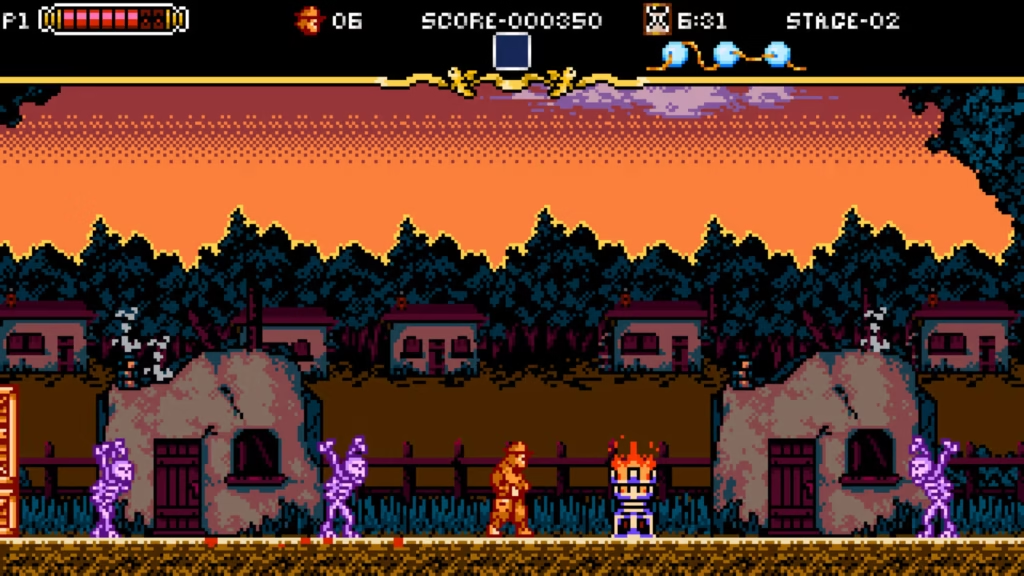
Combat begins simply. Rudiger fights primarily with the Holy Spear and can throw it by expending Rosary Beads, while additional upgrades expand what he can do as the campaign progresses. The downward attack inevitably recalls DuckTales, although the broader rhythm remains much closer to early Castlevania. Positioning matters more than speed, and attacking without considering what is behind an enemy can create an entirely new problem.
The thrown spear is particularly clever because it isn’t restricted to combat. Stick one into certain surfaces and it becomes a temporary platform, opening routes and creating opportunities to reach areas you otherwise couldn’t. It’s a small mechanic that neatly connects Rudiger’s weapon to the platforming rather than leaving combat and traversal in separate boxes.
The fixed jump is going to be the breaking point for some players. Rudiger commits once he leaves the ground, and several later situations demand enough precision that decades of muscle memory from more permissive platformers can work against you. Damage knockback adds another wrinkle. Getting hit beside a pit often means the pit is about to finish what the enemy started.
Yet changing those rules would also alter the level design around them. Enemies are placed with your limited movement in mind. Hazards punish panic. Some foes respawn, while careless attacks can destroy useful pickups before you collect them. Saint Slayer wants you to learn a room and eventually the entire stage, until the same stretch that killed you repeatedly becomes almost routine.
Death commonly means returning to the start of the stage rather than appearing a few metres away. Boss encounters are more forgiving in this regard, restarting at the boss rather than demanding another complete run through the preceding level.
Lillymo does provide an escape hatch for anyone interested in Saint Slayer without wanting quite so much 1980s punishment. Easy Mode removes damage knockback and provides considerably more lives. That’s a meaningful accessibility option in a game where being thrown backwards is responsible for a considerable percentage of the profanity.
Twenty-One Stages Without Twenty-One Variations of the Same Corridor
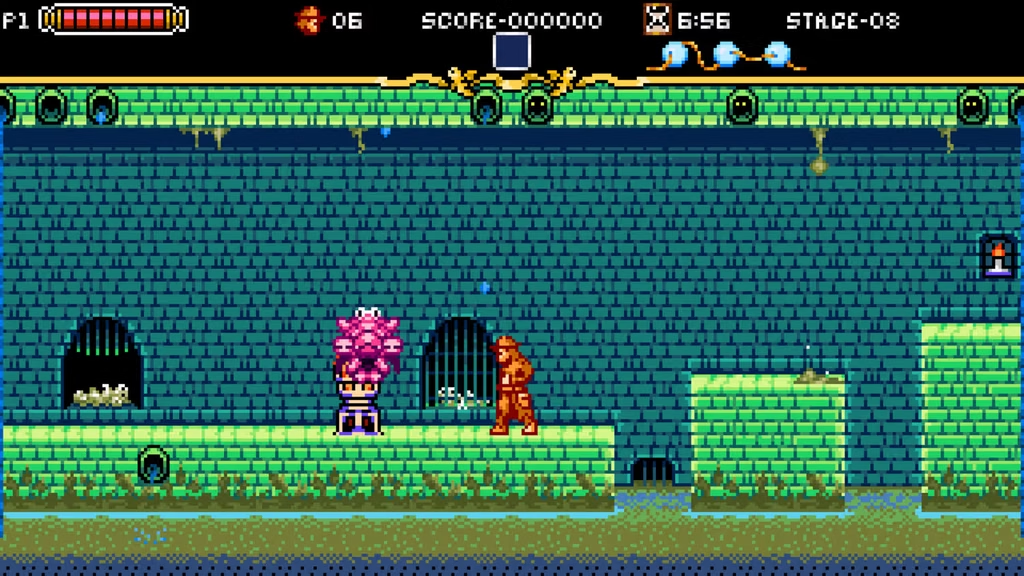
Saint Slayer earns much of its appeal through how often it changes the circumstances around a relatively small mechanical foundation.
Individual stages introduce their own ideas and then move on before every trick has been completely exhausted. There are moving sequences, environmental hazards and scenarios that ask you to apply abilities learned earlier in different ways. The campaign includes stranger diversions such as carriage and boat sections rather than relying exclusively on conventional left-to-right platforming.
It gives the game momentum. Twenty-one stages sound like a lot for something deliberately built around an old-school template, but Saint Slayer rarely feels as though it has run out of things to ask from its mechanics.
The bosses follow the same philosophy of observation and execution. Learning attack patterns matters more than trying to overpower them, and the dedicated restart point means experimenting with those patterns isn’t accompanied by another complete stage run every time Rudiger dies.
Animal familiars, upgrades, treasures, optional challenges and alternate outcomes give players reasons to poke around beyond simply reaching the exit. The password system is another knowingly old-fashioned touch, although here it functions alongside the broader progression rather than existing solely as nostalgia bait.
Pixels, Corpses and Catholic Horror
Visually, Saint Slayer understands the difference between being inspired by the NES and pretending modern hardware doesn’t exist.
Its pixel art maintains the proportions and visual language associated with the era while allowing far more detail in backgrounds, enemies and animation. The religious imagery gets progressively stranger as Rudiger pushes deeper into Pacer’s mess, while the violence provides an amusing contrast to those tiny character sprites. One particularly macabre detail is that Rudiger’s previous corpses can remain behind after death and visibly decay over subsequent attempts.
The chiptune soundtrack is equally comfortable with its influences. It has the punch necessary for repeated stage attempts without sounding like somebody simply fed a Castlevania cartridge through a photocopier.
Player reception since launch has remained extremely positive across both Steam and PlayStation, and it’s easy to understand the enthusiasm. Saint Slayer targets a very particular appetite, then commits to feeding it rather than sanding away everything that could alienate someone outside that audience.
Pros and Cons
Pros
- Clever stage design rewards learning enemy and hazard placement
- The Holy Spear works well across both combat and traversal
- Strong religious setting backed by an actual story and player choices
- Excellent pixel art and chiptune presentation
- Easy Mode meaningfully reduces the punishment for newcomers
- Alternate endings, secrets and challenges encourage repeat runs
Cons
- Fixed jumping requires considerable adjustment
- Knockback deaths become aggravating on tougher stages
- Returning to the beginning after late-stage deaths can feel excessive
- Some of its deliberately archaic ideas remain archaic regardless of intent
Final Verdict
Score: 4.25/5
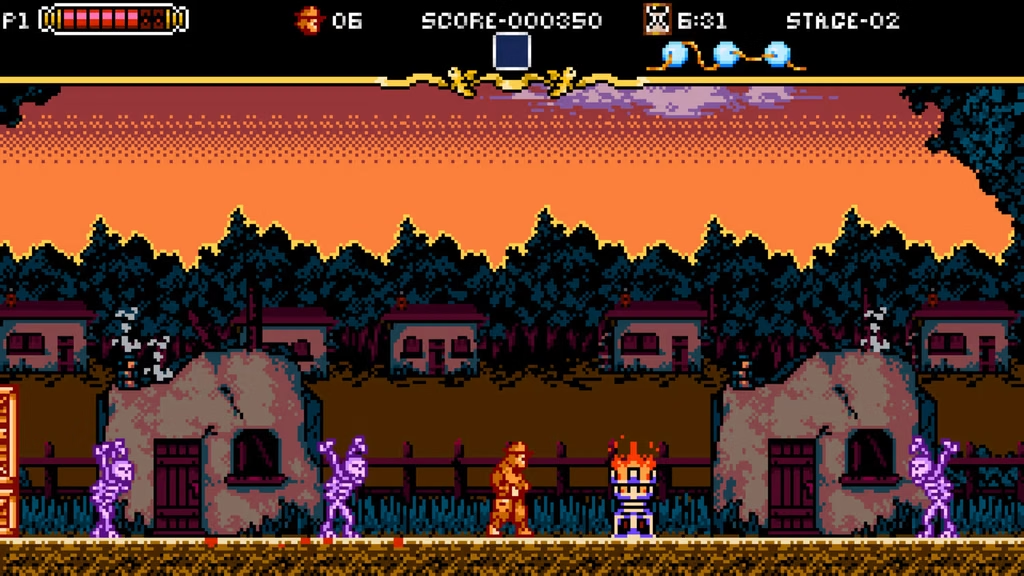
Saint Slayer: Spear of Sacrilege understands something many retro revivals miss. Pixel art is the easy part. Recreating the relationship between limitation, level design and eventual mastery is much harder.
Lillymo gets remarkably close. Rudiger’s fixed movement initially feels restrictive until the stages begin showing why those restrictions exist. Enemy placement becomes information. A spear throw stops being merely an attack once you realise the weapon can create a platform. Even repeated deaths leave a wonderfully morbid record behind as another Rudiger decomposes where your previous attempt ended.
I don’t think every inconvenience inherited from the NES era becomes worthwhile simply because it is authentic. Saint Slayer occasionally pushes repetition further than I wanted, particularly when a mistake near the end of a longer stage means starting again. The 4.25 rather than something higher comes largely from that friction.
What stayed with me, though, wasn’t the frustration. It was how frequently Saint Slayer found its own identity underneath all that obvious Castlevania DNA. The Catholic mythology, Rudiger’s Holy Spear, player choices and willingness to keep changing the shape of its stages prevent it from becoming another exercise in remembering games we already loved.
Saint Slayer clearly worships at the altar of the NES. Thankfully, it brings a few relics of its own.
This review of Saint Slayer: Spear of Sacrilege is based on the PS5 Version, with the code provided by the Publisher/PR Agency.
About The Author