Avinash Rohra
There’s a specific kind of unease that only precision platformers can evoke – a tension born not from what the game shows you, but from what it demands of you. Love Eternal operates squarely in that space. It is, mechanically, a tightly constructed platformer built on exacting inputs and repetition-driven mastery. But what elevates it beyond genre familiarity is how it pairs that mechanical rigor with an atmosphere that feels quietly, persistently unsettling.
You play as a young girl navigating a surreal, fragmented world. Love Eternal offers very little in the way of explicit narrative framing – no lengthy exposition, no clearly defined stakes. Instead, it leans into ambiguity. Its story, whatever shape it ultimately takes, is something you infer rather than something you’re told.
That restraint is deliberate, and it works in the game’s favor.
Death Is Just Another Tutorial
At a mechanical level, Love Eternal is immediately confident. Movement is precise and responsive, built around clean jumps, tight air control, and predictable physics. There’s no friction between player intent and on-screen action – failures rarely feel arbitrary. When you mistime a jump or misread a hazard, the game makes it clear that the mistake was yours.
This clarity is crucial, because Love Eternal is not an easy game.
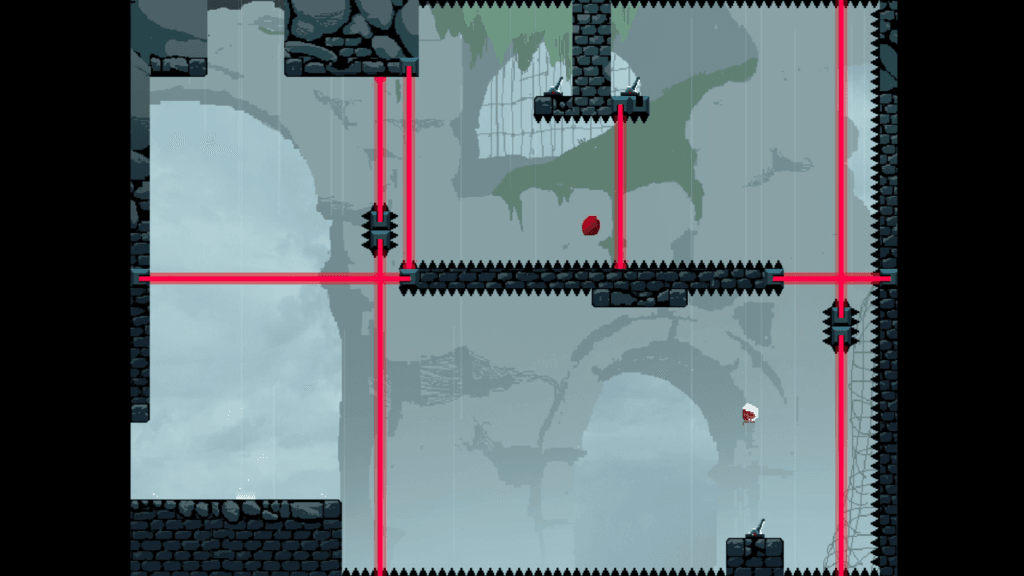
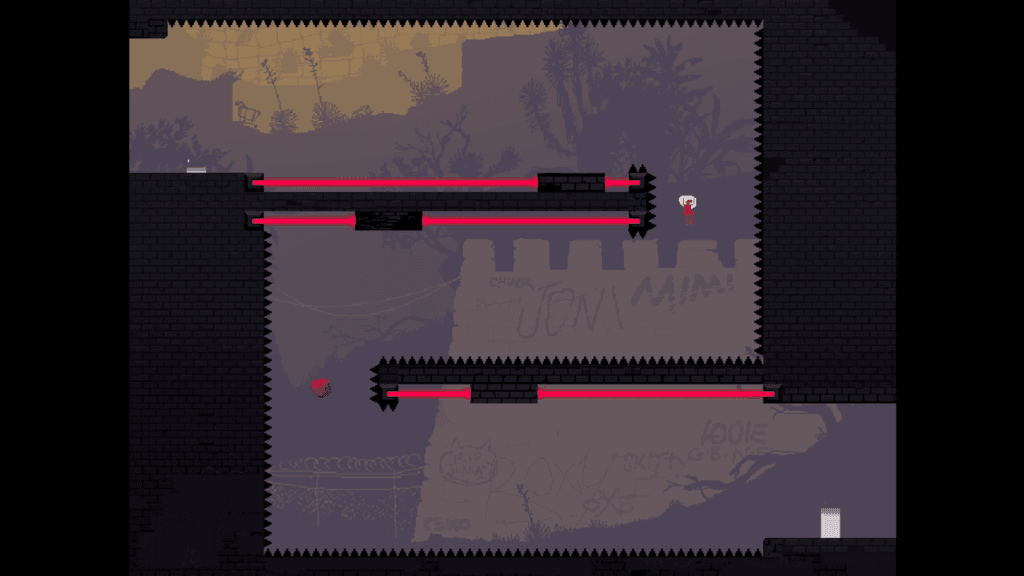
Its challenge is structured through dense, room-based level design that layers hazards in increasingly complex configurations. Spikes, moving elements, narrow safe zones – each screen functions like a compact test of timing and spatial awareness. Progression is iterative: you fail, you restart instantly, and you try again with slightly more information than before. There’s a flow to the process – an almost meditative cycle of failure and refinement that gradually builds toward mastery.
Where the game distinguishes itself is in how it structures that challenge. Many of its rooms ask you to commit fully to movement, sometimes with limited reaction time. You’re not just reacting – you’re anticipating, internalizing patterns, and executing with confidence. The result is a design philosophy that rewards decisiveness as much as precision.
A World That Refuses to Explain Itself

Visually, Love Eternal reinforces its tone through contrast and restraint. Its environments are stylized rather than detailed, often feeling abstract or dreamlike. Spaces can shift from something faintly familiar to something distinctly alien, creating a persistent sense of disorientation. It’s not horror in the traditional sense, but it is undeniably uneasy.
Color and composition play a key role here. The game frequently uses stark visual contrasts and negative space to guide your attention while also amplifying tension. Each room feels self-contained, almost like a fragment of a larger, incomprehensible whole.
The visual design doesn’t simply provide a backdrop for platforming challenges – it actively contributes to the game’s identity. Every new area feels like stepping further into a place that follows its own rules, whether or not you’re ever allowed to understand them.
Silence Speaks Loudest
The sound design complements this approach beautifully. Rather than relying on a constant musical presence, the game uses restraint to its advantage. Ambient audio and minimalist scoring create a sense of isolation, allowing the player’s focus to remain on movement while subtly reinforcing the atmosphere.
Moments of quiet become just as important as moments filled with sound. The result is an experience that constantly keeps players slightly off-balance, contributing to the feeling that something isn’t quite right beneath the surface.
It’s a subtle achievement, but an effective one. Few games understand the value of silence as well as Love Eternal does.
Reading Between the Platforms

Narratively, Love Eternal is best understood through implication. It does not present a clearly defined story about loss or obsession, but it undeniably evokes those ideas. The act of pushing forward through repeated failure, of refusing to stop despite mounting difficulty, can be read as a reflection of persistence taken to its extreme.
That reading isn’t enforced – it emerges naturally from play.
This is where Love Eternal finds much of its thematic weight. The connection between gameplay and interpretation feels intentional, even if the specifics remain open to player interpretation. The experience of retrying the same sequence dozens of times begins to take on emotional texture. What starts as mechanical persistence can start to feel like something more stubborn, more loaded.
Rather than delivering a clear message, Love Eternal creates space for projection. For some players, it may feel like a story about endurance. For others, it may suggest something darker – an inability to let go, a compulsion to continue regardless of cost.
Importantly, the game never resolves these ideas neatly. There is no grand revelation that ties everything together. Instead, it trusts players to draw their own conclusions.
Not for the Faint of Thumb

That approach won’t work for everyone. Players looking for explicit storytelling or emotional closure may find the game too opaque. Likewise, its difficulty – while fair, demands patience and a willingness to engage with repetition.
There are moments where progress slows considerably, where individual rooms can feel more like obstacles than opportunities. Yet even in its toughest stretches, the game remains committed to fairness. Every challenge is conquerable, provided you’re willing to learn from failure and keep trying.
The result is a demanding experience that respects player skill rather than testing endurance through artificial frustration.
Pros
- Excellent precision platforming mechanics
- Fair checkpoint placement and instant restarts
- Strong atmosphere and visual identity
- Ambiguous storytelling that encourages interpretation
- Clever, thoughtfully designed challenge rooms
Cons
- Narrative may feel too vague for some players
- High difficulty can be intimidating
- Repetition-heavy structure won’t appeal to every audience
- Limited accessibility for players unfamiliar with precision platformers
A Precision Platformer That Lingers Long After the Credits
Score: 4.25/5
Love Eternal understands something many games overlook: challenge can be expressive. Difficulty isn’t merely a barrier to progression here; it’s part of the conversation the game is having with the player.
In a genre often defined by speed, spectacle, and leaderboard chasing, Love Eternal takes a more introspective route. It combines exacting platforming with an atmosphere thick enough to leave an impression long after the final jump.
It won’t appeal to everyone. Its narrative ambiguity and demanding difficulty ensure that. But for players willing to embrace uncertainty, Love Eternal offers a memorable blend of mechanical excellence and emotional intrigue.
By the time the credits roll, what remains isn’t simply the satisfaction of overcoming a difficult platformer. It’s the lingering feeling that you’ve spent hours wandering through a dream that never quite wanted to reveal its secrets.
This review of Love Eternal is based on the PC version, with a code provided by the Publishers/PR Agency.
About The Author